
A point system for adults is simple: the things you want to do more of earn points, and the things you want pay them out. Do the workout, get 8 points. Save up 120, and the new running shoes are yours.
Simple to explain, easy to get wrong. Most people’s first version has nothing worth buying, or prices that take months to reach, or rules nobody remembers by week three. This guide covers the three numbers that decide whether it works: what each action is worth, what each reward costs, and how you get paid.
If you’d rather draw it on paper first, the reward chart for adults guide covers the paper version, and token economies for adults explains the psychology behind it. This page is about the numbers.
Step 1: Give every action a point value
Pick two to five actions you actually want to happen this month. “Walk 20 minutes”, “kitchen clean before bed”, “no phone in bed”. Not “get healthy”.
Then give each one a value by how much you’d rather not do it. Doubling works well, because a hard thing should be clearly worth more than an easy one:
| Effort | Points | Examples |
|---|---|---|
| Easy | 1 | drink water, take vitamins, make the bed |
| Medium | 4 | 20-minute walk, 10-minute tidy, read 10 pages |
| Hard | 8 | a full workout, an hour of deep work, meal prep |
| Extreme | 16 | the call you’ve avoided for weeks, a long run |
These are the same four levels Habit Rewards uses (Easy, Medium, Hard and Extreme Hard pay 1, 4, 8 and 16 coins), but nothing about them is magic. What matters is that the dreaded thing pays more than the pleasant thing, so it gets done first.
Three rules that keep values honest:
- Pay for actions, not outcomes. “Gym session” earns points. “Lost 2 lb” doesn’t, because you can’t do it on demand.
- Partial counts. If the goal is 8 glasses of water and you drank 5, earn most of it. An all-or-nothing day gives you no reason to finish the rest.
- Don’t change values mid-week. Adjust on Sunday, not when you’re tired.
Step 2: Price rewards from what you actually earn
This is where most point systems fail. A reward priced at 500 points sounds motivating until you realise a good day earns 13.
Price everything in days of effort, using your own daily total:
- Small (about one good day): an episode, a fancy coffee, a bath, a game session.
- Medium (about one good week): a takeaway, a new book, a cinema trip, a lazy Saturday morning.
- Big (about one good month): shoes, a concert ticket, a gadget, a day trip.
Work out your numbers here. Enter how many of each kind of action you do on a good day:
Point system calculator (Easy 1, Medium 4, Hard 8, Extreme 16)
The defaults (2 easy, 2 medium, 1 hard, 5 good days a week) earn 18 points a day and 90 a week, so a takeaway costs about 90 and a concert ticket about 360. Those numbers feel reachable, and that’s the point.
Keep at least five small rewards on the list. Small rewards are what you’ll actually claim on an ordinary Tuesday, and claiming them is what teaches your brain the system is real. Stuck for ideas? There are 70 ways to reward yourself and reward jar ideas with prices.
Step 3: Decide how you get paid
Write these down once, so you’re not renegotiating with yourself every evening:
- Points go in the moment you finish, not at the end of the week. The quick payoff is the whole trick.
- You claim a reward when the balance covers it. No credit, no “I’ll earn it tomorrow”.
- Claimed means spent. Take the points off and then enjoy the reward, guilt-free. That’s what they were for.
- No taking points away, at least for the first month. Penalties turn the system into something you avoid looking at. A planned day off is fine: in Habit Rewards, a Skip costs 10 coins and keeps your streak alive.
- Review once a week. Raise the value of anything you keep skipping, drop rewards you’ve stopped wanting, add one new one.
Three point systems you can copy
Getting fit
| Action | Points |
|---|---|
| 8,000 steps | 4 |
| Workout | 8 |
| Stretch 10 minutes | 1 |
| Long run or class you’ve been avoiding | 16 |
Rewards: smoothie out 15, new playlist and a bath 20, massage 120, running shoes 400.
Home and admin
| Action | Points |
|---|---|
| Dishes done before bed | 4 |
| One load of laundry, folded | 4 |
| 10-minute tidy | 1 |
| The admin task you keep postponing | 16 |
Rewards: an episode 10, takeaway night 80, a cleaner for one visit 300.
Study or deep work
| Action | Points |
|---|---|
| 25-minute focus session | 4 |
| Reading 20 pages | 4 |
| Inbox to zero | 8 |
| Finish a chapter or project milestone | 16 |
Rewards: coffee from the good café 15, an evening off 60, a new book 90, a weekend away 500.
A chore point system for adults
Chore point systems for adults usually come up in shared homes: flatmates, couples, adult children living at home. They work when they’re about fairness of effort, not about who did more.
- Value chores by time and unpleasantness, not by how visible they are. Cleaning the bathroom is worth more than watering plants, even though both take 10 minutes.
- Agree the list together. Everyone helps set the values, so nobody feels cheated by the rules later.
- Each person keeps their own balance and their own reward list. One person’s reward is a new video game, another’s is a Saturday lie-in. Nobody needs to approve anyone’s treats.
- Share the house rewards. A takeaway or a cleaner’s visit can be a shared goal that everybody’s points count towards.
- Don’t publish a leaderboard. Comparing totals turns chores into a competition, and that rarely ends well.
More chore ideas with prices: how to reward yourself for cleaning and the free chore chart maker.
A couples point system
A couples point system can be fun, but only if both people want it and it’s about each person’s own goals. Two versions that work:
- Side by side: each of you earns points for your own habits (gym, reading, sleep) and you each buy your own rewards. You cheer each other on; neither of you scores the other.
- A shared pot: you both earn towards one joint reward, like a date night at 150 points or a weekend away at 600. Good for shared goals such as cooking at home or a savings streak.
What doesn’t work: points for favours, affection or “being nice”. Once kindness has a price, it starts to feel like a transaction, and that’s the opposite of what you wanted.
Paper, spreadsheet or app?
Paper is great for the first week: a sheet on the fridge, a tally per action, the reward list underneath. Try the printable habit tracker or the adult sticker chart.
A spreadsheet keeps the totals for you; our free habit tracker spreadsheet already pays coins per habit and has a reward list.
An app keeps the balance in your pocket and pays you the second you check something off. Habit Rewards is the app we make around exactly this kind of system:
- Every habit pays coins: pick Easy, Medium, Hard or Extreme Hard (1, 4, 8 or 16), or set any amount.
- Habits with a count, like 8 glasses of water, pay as you go.
- Rewards sit in a list with a coin price, and you claim one when your balance covers it.
- One-off tasks pay coins too, and a Skip costs 10 coins.
- Custom coins give a goal its own currency, such as Fitness Coins that only buy fitness rewards.
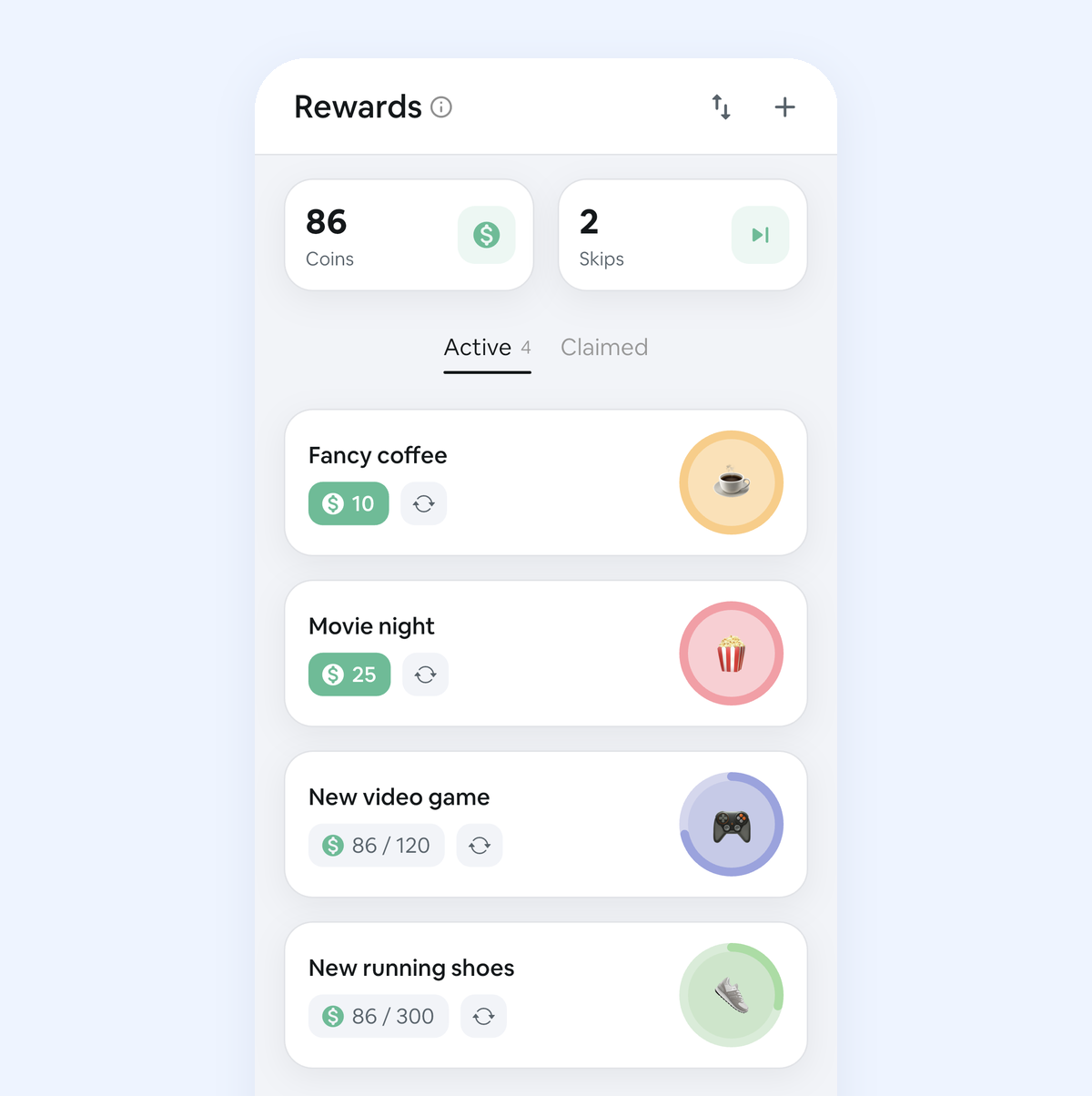
It’s free for three habits on iPhone and Android. Each person uses their own app, so it fits the side-by-side version above. Comparing apps? See apps that reward you for completing habits.
FAQ
What is a point system for adults? A way to reward yourself for habits and tasks: each action earns points, and you spend the points on rewards you’ve priced in advance. It’s the same idea as a token economy or a reward chart, just with a running balance.
How many points should a reward cost? Base it on what you earn. A small reward should cost about one good day’s points, a medium one about a week, a big one about a month. Use the calculator above to get your numbers.
Should I lose points for missing a day? We wouldn’t, at least at first. Penalties make people stop checking the system. Pay a little for a minimum version on bad days and allow planned days off instead.
Does a point system work for adults with ADHD? Often, because the points arrive immediately. We wrote a separate guide on that: ADHD reward system for adults.
Is there a point system app for adults? Yes. Habit Rewards pays coins and Habitica pays gold for habits, and a few others do something similar; we compared them in apps that reward you for completing habits. Habit Rewards lets you set what each habit pays and what each reward costs.
Quick recap
- Two to five actions, valued by effort: 1, 4, 8, 16.
- Prices from your real earnings: a day, a week, a month.
- Points the moment you finish, claim when you can afford it, no penalties.
- Review on Sunday: change values and rewards, not the rules.
- Shared homes: everyone keeps their own balance and their own rewards.
✅ Try Habit Rewards: the habit tracker that pays you
Every habit pays coins by how hard it is (1, 4, 8 or 16). Write your own reward list, put a coin price on each treat, and claim it once you've earned it.
- Daily, weekly and monthly habits, plus one-off tasks that pay coins
- Reminders, streaks and home-screen widgets
- A 10-coin Skip for the days you can't
- Free for three habits, on iPhone and Android

On a computer? Scan the code with your phone (it opens the App Store or Google Play), or get it on the App Store.

Using Notion?
Start with our free Notion habit tracker and formulas, or get the aesthetic Notion Habit Tracker template with heatmaps and streaks.
More articles you may be interested in:
- Free Notion Habit Tracker Templates (and How to Build Your Own)
- Trigger, Behavior, Reward: The Habit Loop Explained With Examples
- Workout Reward Chart for Adults: Free Printable 100-Workout Chart
- Weight Loss Reward Chart: Free Printable and Reward Ideas for Every Milestone
- Way of Life App Review: Free vs Premium, and the Android App
- Todoist Habit Tracker: How to Track Habits in Todoist (and Its Limits)
Rather track it on your phone? In Habit Rewards every check-off earns coins, and you spend them on rewards you set yourself. Free on iPhone and Android for up to 3 habits.
Get the appFree habit tools and printables
Free, in your browser, no sign-up.