
A reward system for adults sounds like a sticker chart with a bigger budget. With ADHD it’s closer to a tool: a way to make the payoff for boring, important things show up today instead of in six months.
Most of the ones people set up stop working within a few weeks, though. The rewards are too far away, the system gets boring, or one bad day knocks the whole thing over. This guide is about building one that survives all three.
A note before we start: this is about motivation and everyday habits, not treatment. If ADHD is getting in the way of work, money or relationships, talk to a doctor or an ADHD coach.
Why rewards work differently with ADHD
Later feels like never. Researchers have studied this for decades. Sonuga-Barke’s “delay aversion” model and a 2016 meta-analysis by Jackson and MacKillop both describe the same pattern: people with ADHD tend to discount rewards more steeply the further away they are. A reward at the end of the month competes badly with anything that’s fun right now.
Novelty wears off fast. The reward that felt exciting on Monday is background noise by Friday. A system with the same three rewards forever runs out of pull.
All or nothing. Many reward systems only pay when you’ve done everything. Miss one item and the day pays zero, so there’s no reason to do the other four.
Out of sight, out of mind. If you can’t see what you’ve earned or what you’re saving for, the system goes quiet in your head, and then it stops.
So a reward system that works with ADHD needs four things: something you get the moment you finish, a menu that stays interesting, a balance you can see, and rules for bad days.
How to build an ADHD reward system, step by step
1. Pick three things to reward
Three specific actions, not life goals. “Take meds with breakfast”, “10-minute tidy”, “reply to one email I’ve been avoiding”. When one becomes automatic, swap it for something new. Need ideas? See 100 habit ideas.
2. Pay points the moment you finish
This is the part that answers “later feels like never”. You don’t get the big reward today, but you get points today, the second you finish. Harder things pay more, so the dreaded task is worth doing first:
| Action | Points |
|---|---|
| Easy (glass of water, meds) | 1 |
| Medium (10-minute tidy, a walk) | 4 |
| Hard (workout, an hour of deep work) | 8 |
| The thing you’ve avoided for weeks | 16 |
Each item pays on its own. Do two of three and you still earn two-thirds: no all-or-nothing. Psychologists call this a token economy; more in token economies for adults.
3. Price a reward menu in three sizes
Points only work if they buy something you want. Write a menu and price every item. A simple rule: small rewards cost about one good day, medium about one good week, big about one good month. With three habits worth 4 + 4 + 8 points, a good day earns 16:
| Size | Price | Earned in | Example |
|---|---|---|---|
| Small | 10–20 | a day | an episode, a fancy coffee |
| Medium | 60–100 | a week | takeaway night, a new book |
| Big | 300–500 | a month | concert ticket, new headphones |
Keep lots of small rewards on the menu. They’re what you’ll actually claim on an ordinary Tuesday, and each claim teaches your brain that the points are real.
4. Make the balance visible
Put your balance and the next reward somewhere you look every day: the fridge, your phone’s home screen, a sticky note on your monitor. “34 of 80 points to takeaway night” pulls harder than a number in a notebook.
5. Write the bad-day rules now
- No taking points away for a missed day. Earning should feel good; losing points for a bad day makes you avoid the system.
- A minimum version counts. Five push-ups is a workout on a bad day. Pay the easy rate for it.
- Allow planned days off. Sick days and travel days shouldn’t wreck a streak you’ve built. Some people let themselves buy a day off with points.
6. Rotate the menu every Sunday
Five minutes a week. Cross off rewards you haven’t wanted in two weeks, add one new thing, and adjust prices: a reward nobody ever claims is too expensive, one you claim every day is too cheap. New items are how the system keeps its novelty.
60 ADHD reward ideas for adults
Sorted by size, with prices that fit the rule above. Change the numbers to fit your week.
Instant (5–10 points)
- A fancy coffee or tea
- One episode of your show
- 20 minutes of guilt-free gaming
- 15 minutes of scrolling, on a timer
- A favourite snack
- A song you love, played loud
- A sticker for your planner
- A 15-minute nap
- A walk with a podcast
- A face mask or a long shower
- Ten minutes on a hobby you’ve been “saving” for later
- Texting a friend instead of answering email
Small (15–30 points)
- A new phone game or app
- A takeaway lunch
- A long bath with a book
- An evening with zero chores
- An hour of a video game
- A magazine or a comic
- A plant for your desk
- New stationery or a nice pen
- A smoothie or bubble tea
- Ordering the fun version instead of the cheap one
- A movie at home with good snacks
- One hour of free time with no to-do list
Medium (60–120 points)
- Takeaway dinner
- A new book or audiobook
- A cinema ticket
- A month of a streaming service you’d cancelled
- A class: climbing, pottery, dance
- New workout clothes
- A board game or a puzzle
- A day off from cooking
- A video game you’ve been eyeing
- Brunch out with a friend
- A haircut somewhere nicer than usual
- A craft kit or a LEGO set
- A massage
Big (300–600 points)
- Concert or theatre tickets
- New headphones
- A weekend away
- A gadget you’ve wanted for months
- A good pair of shoes
- A day trip somewhere new
- Upgrading something you use every day: a chair, a keyboard, a pillow
- A course or workshop
- A spa day
- A new piece of hobby gear
Novelty rewards (rotate these in when the menu feels stale)
- A restaurant you’ve never tried
- A mystery box or a surprise order
- A new route for your walk or run
- A museum or gallery you haven’t been to
- A new recipe with fancy ingredients
- An escape room
- A different coffee shop to work from
Social rewards (often the strongest for ADHD)
- A call with a friend you miss
- A games night
- Coffee with someone who makes you laugh
- Co-working with a friend
- Inviting people over for dinner
- A day out with your partner or family
Want more? There are 70 in ways to reward yourself, and a dopamine menu builder that sorts quick boosts from bigger ones.
Rewards that backfire
- Open-ended rewards. “I’ll scroll until I feel like stopping” turns a 15-minute reward into a lost evening. Put a timer on it, or use an earn-your-screen-time chart.
- Rewards that undo the habit. A cake for a week of healthy eating can work, or it can restart the cycle. You know which one you are.
- Rewards you’d get anyway. If you always watch an episode after dinner, it isn’t a reward. Pick things you’d otherwise skip or feel guilty about.
- Money you don’t have. Big rewards should be things you’d buy anyway, now with a reason. Plenty of the best rewards are free: time, permission, people.
- Punishment. Fines and lost privileges for missed days feel motivating on day one and make you avoid the system by day ten.
Paper token board or app?
Paper is free, sits on the fridge and has no notifications to ignore. A token board for adults is just a row of boxes and “I’m working for: ___”. It gets harder once you’re saving for several rewards, because you keep the balance by hand. Our free reward tracker and printable habit tracker are a good start.
An app keeps the balance for you and lives on your home screen. Habit Rewards is the app we make around this exact system:
- Each habit pays coins by how hard it is: Easy, Medium, Hard or Extreme Hard.
- Your rewards sit in a list with a coin price, and you claim one when your balance covers it.
- You can trade 10 coins for a Skip, which keeps your streak on a day off.
- One-off tasks pay coins too, so “call the dentist” can earn something.
- Reminders, streaks and home-screen widgets keep it in sight.
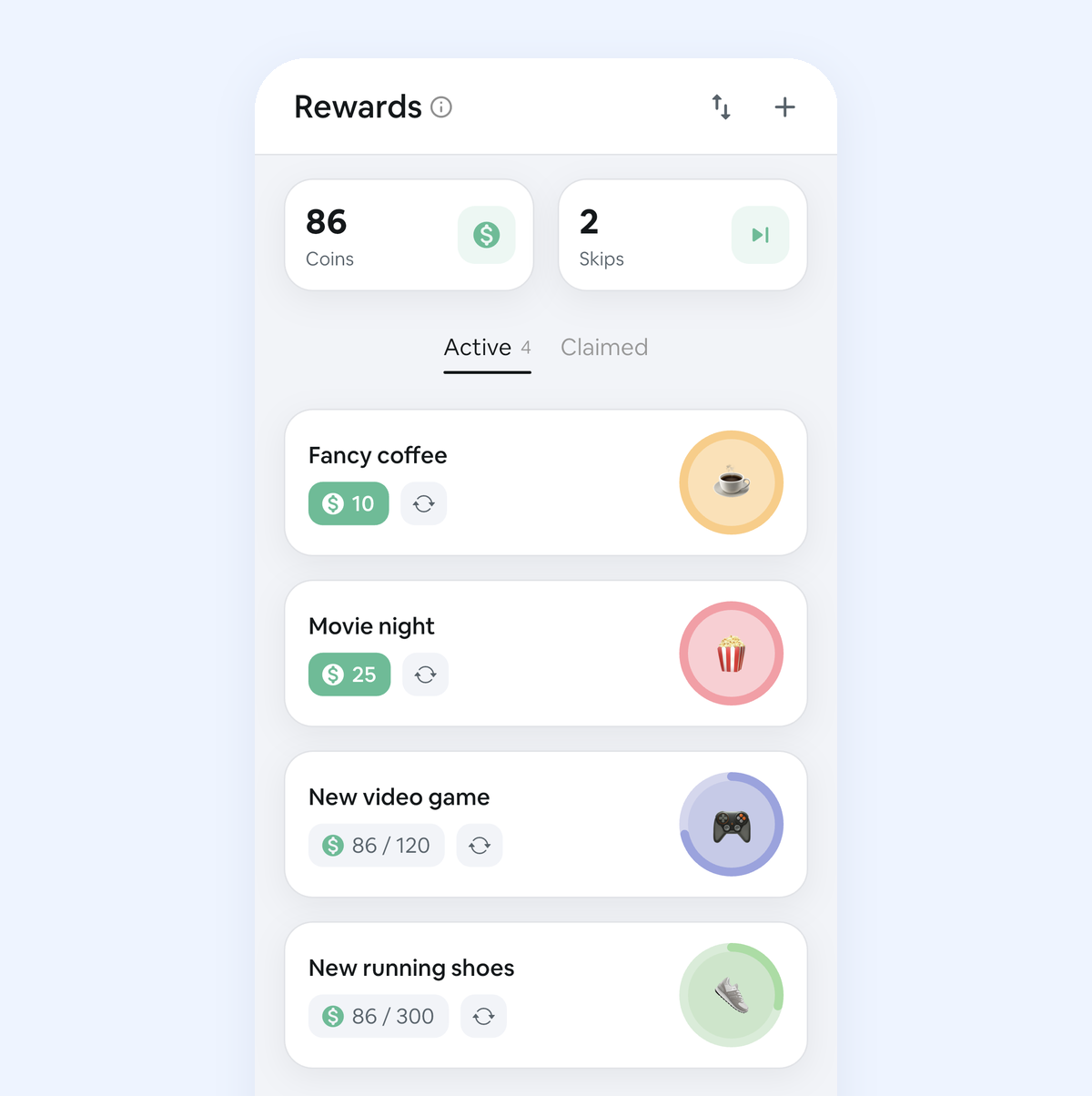
It’s free for three habits on iPhone and Android, which is the right number to start with anyway. Comparing apps? See apps that reward you for completing habits and Joon for adults.
FAQ
Does a reward system work for adults with ADHD? It can, when the payoff is immediate. Points you earn the moment you finish bridge the gap between doing something boring now and getting something good later. It works best alongside whatever else helps you, not instead of it.
What are good rewards for ADHD adults? A mix: lots of small, instant rewards you can claim on an ordinary day, a few medium ones for a good week, and one big goal. Rotate new things in every week or two, because novelty is part of what makes a reward work.
How do I stop my reward system from getting boring? Change the menu, not the rules. Add one new reward a week, drop the ones you’ve stopped wanting, and keep a few novelty and social rewards on the list.
Should I take points away when I miss a day? We wouldn’t. Losing points makes the system feel like a punishment, and that’s when people stop opening it. Pay less for a minimum version instead, and allow planned days off.
Is rewarding myself just bribing myself? It’s the same trick schools, workplaces and games use: make the effort pay something now. The difference is that you set the prices, and you pick rewards that are good for you.
Quick recap
- Three specific things to reward.
- Points the moment you finish, more for harder things.
- A priced menu: small ≈ a day, medium ≈ a week, big ≈ a month.
- A balance you can see every day.
- No point penalties; minimum versions and days off count.
- Rotate the menu every Sunday.
Setting up the habits side? Read how to set up an ADHD habit tracker.
✅ Try Habit Rewards: the habit tracker that pays you
Every habit pays coins by how hard it is (1, 4, 8 or 16). Write your own reward list, put a coin price on each treat, and claim it once you've earned it.
- Daily, weekly and monthly habits, plus one-off tasks that pay coins
- Reminders, streaks and home-screen widgets
- A 10-coin Skip for the days you can't
- Free for three habits, on iPhone and Android
On a computer? Scan the code with your phone (it opens the App Store or Google Play), or get it on the App Store.
Using Notion?
Start with our free Notion habit tracker and formulas, or get the aesthetic Notion Habit Tracker template with heatmaps and streaks.
More articles you may be interested in:
- Free Notion Habit Tracker Templates (and How to Build Your Own)
- Trigger, Behavior, Reward: The Habit Loop Explained With Examples
- How to Reward Yourself for Good Habits (Without Undoing Them)
- Habit Tracker Apps for Teens: 6 That Don't Feel Like a Kids' App
- Chore Apps for Adults: 6 Compared by What Keeps You Cleaning
- Apps That Reward You for Completing Habits: 8 With a Real Reward System
Rather track it on your phone? In Habit Rewards every check-off earns coins, and you spend them on rewards you set yourself. Free on iPhone and Android for up to 3 habits.
Get the appFree habit tools and printables
Free, in your browser, no sign-up.