
Reward jars aren’t only for kids. A jar on your desk is a reward system you can see from across the room, and that is exactly what most adult reward systems are missing. A note on your phone is easy to forget. A jar that’s two-thirds full is hard to ignore.
There are two kinds, and they do different jobs:
- A fill-the-jar saves up toward one big reward. Every time you do the habit, a marble goes in. When it’s full, you get the thing.
- A lucky-dip jar pays out right away. Every time you do the habit, you draw a slip and get whatever it says.
Here’s how to set up each one, and how to keep it working after the first fortnight.
The fill-the-jar (marble jar)
What you need: a clear jar, and something to drop in it: marbles, dried beans, buttons, pom-poms. Clear matters. Watching the level rise is half the reward.
How to set it up:
- Pick one reward you really want, big enough to wait for: the concert tickets, the new running shoes, a day off with no plans.
- Decide what earns a marble. One or two habits, written down. “Gym session = 1 marble” works. “Be healthier = 1 marble” doesn’t.
- Size the jar to two to four weeks. Count how often you’ll realistically do the habit and set the target to match. Gym three times a week for four weeks is 12 marbles. A jar that takes six months to fill feels empty forever.
- Pay more for harder things. If you track more than one habit, the hard one earns two or three marbles and the easy one earns one.
- Never take marbles out. A bad week means the jar fills more slowly, not that it empties. Losing progress is the fastest way to stop caring about the jar.
10 fill-the-jar goals, with marble counts
| Habit | Marble rule | Jar target | Reward when full |
|---|---|---|---|
| Gym or a run | 1 per session | 12 (about 4 weeks) | New trainers or gym gear |
| Reading | 1 per 20 pages | 30 | The next book in hardcover, plus a café afternoon |
| Saving money | 1 per $10 not spent on takeaway | 20 | Half of it on a nice dinner out |
| Studying | 1 per focused hour | 25 | A weekend day with no study at all |
| Cooking at home | 1 per home-cooked dinner | 15 | A cooking class or a new knife |
| Early mornings | 1 per day up on time | 20 | A massage |
| No-spend days | 1 per day | 14 | One thing from your wish list |
| Cleaning | 1 per room done | 20 | A cleaner for a deep clean |
| Language practice | 1 per lesson | 30 | A trip, or a meal at a restaurant of that country |
| Quitting something | 1 per clean day | 30 | Whatever the money you didn’t spend adds up to |
The lucky-dip jar (draw a slip)
What you need: any jar, and slips of paper folded so you can’t read them.
How it works: finish the habit, draw one slip, do what it says today. A surprise makes the moment more fun than a reward you saw coming, and it stops one treat from wearing out.
The rules that make it work:
- Only write slips you’ll honour every time. If a slip says “buy something for $50”, you’ll draw it on a broke week and quietly put it back. After that, the jar is optional. Keep slips small, free or cheap, and doable today.
- Mix the sizes. Lots of small slips, a few medium ones, one or two jackpots (“the evening is yours, no chores”).
- No draw without the habit. The jar only works if it’s the payoff for something. Drawing on a day you skipped turns it into a treat jar.
- Weed it monthly. Take out the slips that made you sigh, and add new ones.
40 reward slip ideas
Free
- A guilt-free episode of your show
- 30 minutes of your game
- A long bath or shower with no phone
- A nap
- A walk somewhere you like, with a podcast
- Call a friend you’ve been meaning to call
- An hour of a hobby, no strings attached
- Go to bed early with a book
- Skip one chore tonight (someone else’s turn, or tomorrow’s)
- Watch the sunset, properly
- A lie-in tomorrow
Under $5
- A fancy coffee
- Your favourite snack
- A new song or album you’ll play on repeat
- Fresh flowers for the desk
- A face mask
- A good chocolate bar
- A new pen or notebook
- A magazine
Under $20
- A takeaway lunch
- A new paperback
- A cinema ticket
- A plant
- A candle you like the smell of
- A game on sale
- Nice bread and cheese for dinner
- A class or app subscription for one month
Time and experiences
- A morning off from the to-do list
- A visit to a museum or gallery
- Breakfast out
- A day trip on the weekend
- An evening with no plans and no phone
- A swim
- A board game night with friends
Jackpots (one or two in the jar)
- The whole evening is yours, no chores
- Pick the weekend plans
- Something from your wish list (set a cap you’re happy with)
- A massage
- A day off
- Dinner at the restaurant you’ve been saving
Need more? We keep a longer list of 70 ways to reward yourself, sorted by price.
Use both
The two jars fit together well. Each habit gets you a draw from the lucky-dip jar and a marble in the fill-the-jar. The small slips get you through today, and the marbles build up to the big thing. If that sounds like a points system, it is: a jar is the simplest token economy for adults there is.
When the jar stops working
Jars usually fail the same few ways:
- It got too slow. Make the next jar smaller.
- The reward wasn’t wanted. Fill-the-jar rewards should be things you’d actually be upset to miss.
- Too many habits feed it. Back to one or two.
- It’s out of sight. Put it where you see it every day: by the kettle, on the desk.
- You’re tracking more than a jar can show. Once you have several habits, each worth a different number of marbles, and a list of rewards at different prices, a jar gets fiddly. That’s the point where an app is easier.
The digital version
Habit Rewards is a reward jar on your phone. Every habit pays coins when you check it off, 1, 4, 8 or 16 by how hard it is. You write your own rewards and give each a coin price, from a coffee to the concert tickets, and claim one when your balance covers it. Streaks, reminders and one-off tasks are in there too.
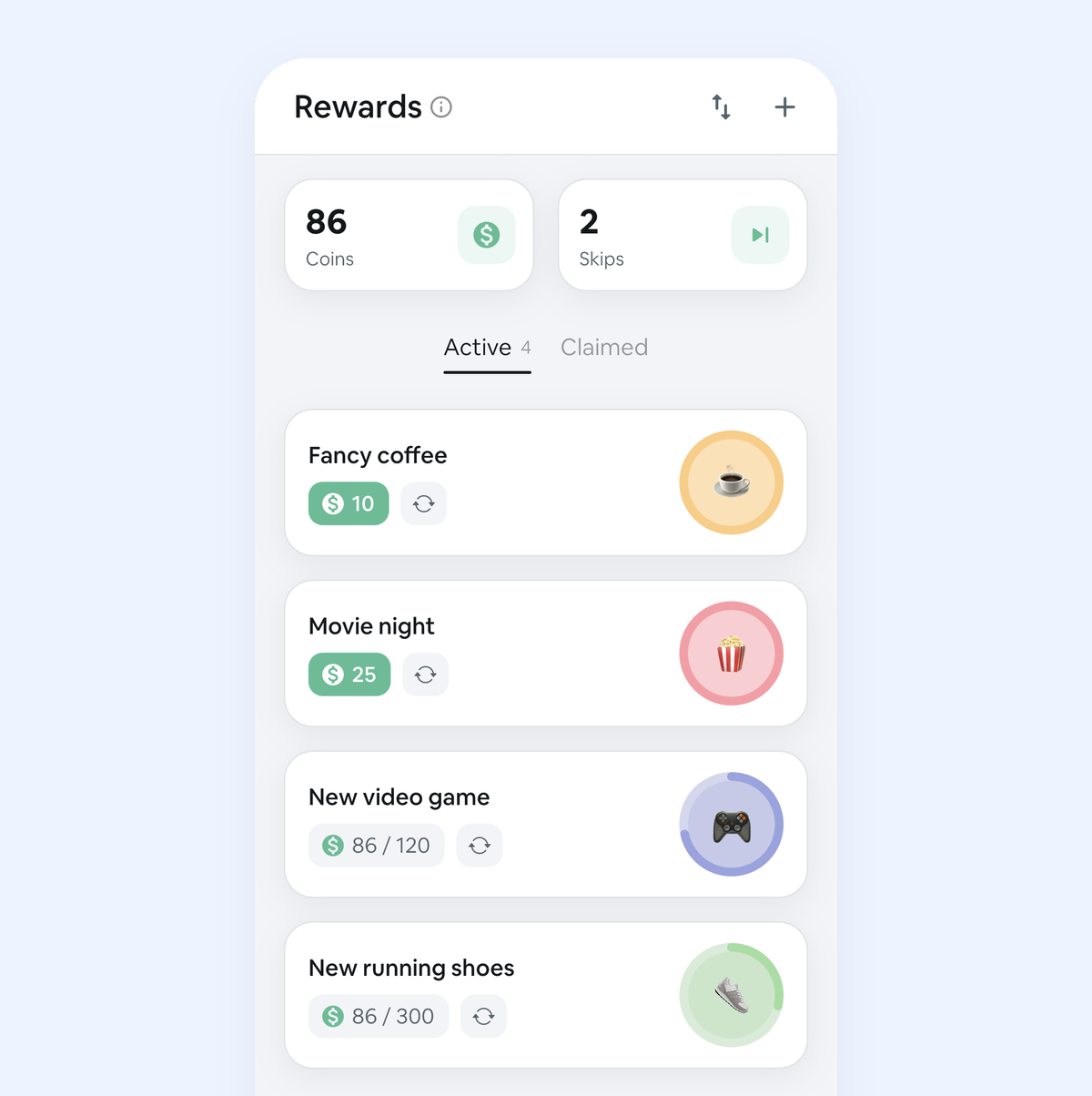
It’s free for three habits and three rewards on iPhone and Android.
FAQ
What is a reward jar for adults? A jar that makes your progress visible. Either you add a marble every time you do a habit and get a big reward when it’s full, or you draw a slip with a small reward each time you do the habit.
How many marbles should a reward jar have? Enough to fill in two to four weeks of real effort. Count how often you’ll do the habit in that time, and set the target there. A long wait for the first jar is the most common reason people give up.
What do you put in a reward jar? For a fill-the-jar: marbles, beans, buttons or anything else you can count. For a lucky-dip jar: folded slips, each with a small reward you can do the same day, like an episode of your show, a fancy coffee or an early night.
Should you take marbles out for a bad day? For adults, no. Missing a day already means the jar fills more slowly. Taking marbles out makes a bad week feel like lost progress, which is when people give up on the jar.
Do reward jars work for ADHD? Many adults with ADHD find a quick, visible payoff makes it easier to start a task, and a jar is very visible. It isn’t a treatment, but it can help a routine stick. Our ADHD habit tracker guide has more setups.
✅ Try Habit Rewards: the habit tracker that pays you
Every habit pays coins by how hard it is (1, 4, 8 or 16). Write your own reward list, put a coin price on each treat, and claim it once you've earned it.
- Daily, weekly and monthly habits, plus one-off tasks that pay coins
- Reminders, streaks and home-screen widgets
- A 10-coin Skip for the days you can't
- Free for three habits, on iPhone and Android

On a computer? Scan the code with your phone (it opens the App Store or Google Play), or get it on the App Store.

Using Notion?
Start with our free Notion habit tracker and formulas, or get the aesthetic Notion Habit Tracker template with heatmaps and streaks.
More articles you may be interested in:
- Free Notion Habit Tracker Templates (and How to Build Your Own)
- Trigger, Behavior, Reward: The Habit Loop Explained With Examples
- How to Reward Yourself for Weight Loss: 50 Non-Food Rewards
- Habitica Habits vs Dailies vs To Do's: Which to Use (With Examples)
- How to Reward Yourself for Reading More
- How to Reward Yourself for Cleaning the House
Free habit tools and printables
Free, in your browser, no sign-up.