
What a token economy is
A token economy is a reward system with three parts:
- Target behaviors: the specific things you want to do more often.
- Tokens: points, coins or stars you earn the moment you do them.
- Backup rewards: the things you can trade your tokens for.
The idea comes from behavior therapy. Teodoro Ayllon and Nathan Azrin ran one of the first token economies in a psychiatric hospital in the 1960s and described it in their 1968 book The Token Economy. Since then the same structure has been used in classrooms, in therapy for children and teenagers, and in workplaces.
You don’t need a therapist to use it on yourself. As an adult you play every role: you choose the behaviors, you pay the tokens, and you run the shop.
Why it works
Most good habits pay off late. A workout today shows up in your health months from now. A study session pays off at the exam. The effort is now and the reward is someday, which is exactly the kind of trade people are bad at.
A token economy puts something in between. You get a token right after the behavior, and the tokens add up to a reward you actually want. The habit has something to show for itself the same day.
The same idea, a payoff that arrives right away instead of someday, is why some adults with ADHD build a version of this for themselves. It isn’t a treatment, just a structure that makes progress visible.
How to set up your own token economy
1. Pick two to four target behaviors
Start small. Two to four behaviors is enough for the first month. Each one needs a clear finish line, so there is never a debate about whether you earned the token:
- “Walk for 20 minutes”, not “exercise more”
- “Read 10 pages”, not “read more”
- “Study for 45 minutes with the phone in another room”, not “study”
2. Choose your tokens and set a pay rate
Your tokens can be anything you can count: marbles in a jar, ticks on a card, or coins in an app. What matters is the pay rate. Harder or less pleasant behaviors should pay more, so they stay worth doing.
A simple scale with four levels covers most habits:
| Effort | Tokens | Example |
|---|---|---|
| Easy | 1 | Drink a glass of water after waking up |
| Medium | 4 | Read 10 pages |
| Hard | 8 | 45-minute study session |
| Very hard | 16 | Two hours on the side project |
3. Build a reward menu and price it
The backup rewards are what make the system work. Write down rewards you actually want, then give each one a price in tokens. Mix three sizes:
- Small, about one day’s earnings: a fancy coffee, an episode of your show, a long bath.
- Medium, about a good week: a takeaway dinner, a new book, a movie night.
- Large, about a month: new running shoes, a concert ticket, a weekend away.
Small rewards keep the first week exciting. Large ones give you something to save for.
4. Set the exchange rules
Decide the rules before you start, while you’re being reasonable:
- You can only buy a reward when you have the tokens. No credit.
- You don’t take the reward anyway on a day you didn’t earn it.
- Tokens don’t expire, so saving up for something big is always possible.
5. Leave out penalties at first
Some token economies take tokens away for unwanted behavior. In behavior therapy this is called response cost. For a system you run on yourself, start without it. Missing a day already costs you the tokens you didn’t earn, and a system that mostly punishes is one you’ll quietly stop using.
6. Review once a week, then fade
Spend five minutes a week on it:
- Is a behavior too easy or too hard for what it pays? Change the rate.
- Is there a reward you’re not saving for? Replace it with one you want.
- Has a behavior become automatic? Lower its pay or retire it, and add the next one on your list.
That last step is called fading. The goal is not to pay yourself forever for brushing your teeth. Tokens get a habit started, and once it runs on its own, they move on to the next one.
A worked example
Say you pick three behaviors:
| Behavior | Tokens per day |
|---|---|
| 20-minute walk | 4 |
| Read 10 pages | 4 |
| 45-minute study session | 8 |
A perfect day pays 16 tokens and a perfect week pays 112. Nobody is perfect, so plan around a good week of about 90.
Price the menu from those numbers: small rewards at 10 to 20 tokens, medium ones at 60 to 90, and one large reward at around 400, about a month of good weeks. If after two weeks you’re buying something every day, your prices are too low. If you haven’t bought anything, they’re too high or the rewards aren’t tempting enough.
Common mistakes
- Too many behaviors. Ten behaviors on day one turns the system into a list of things you’re failing at.
- Vague behaviors. If you have to argue with yourself about whether something counts, it will stop counting.
- Rewards you don’t care about. A token economy runs on wanting the rewards. Pick things that are a real treat for you.
- Inflation. Paying yourself extra “because it was a hard day” makes every token worth less. Change the rates in your weekly review instead.
- Never fading. If every habit you’ve ever started still pays, the menu gets expensive and the newest habit gets lost. Retire the automatic ones.
Paper or app?
A jar of marbles and a list on the fridge is free and works fine for one or two behaviors. Once you track several behaviors and save for bigger rewards, keeping the running balance by hand gets tedious, and a system that’s tedious to run doesn’t last.
Habit Rewards is a habit tracker built as a token economy. Each habit pays the coins you set for it, with presets of 1, 4, 8 and 16 coins by difficulty. Your rewards sit in a list with a coin price. When your balance covers a reward, you claim it, and the app keeps the running total and your streaks.
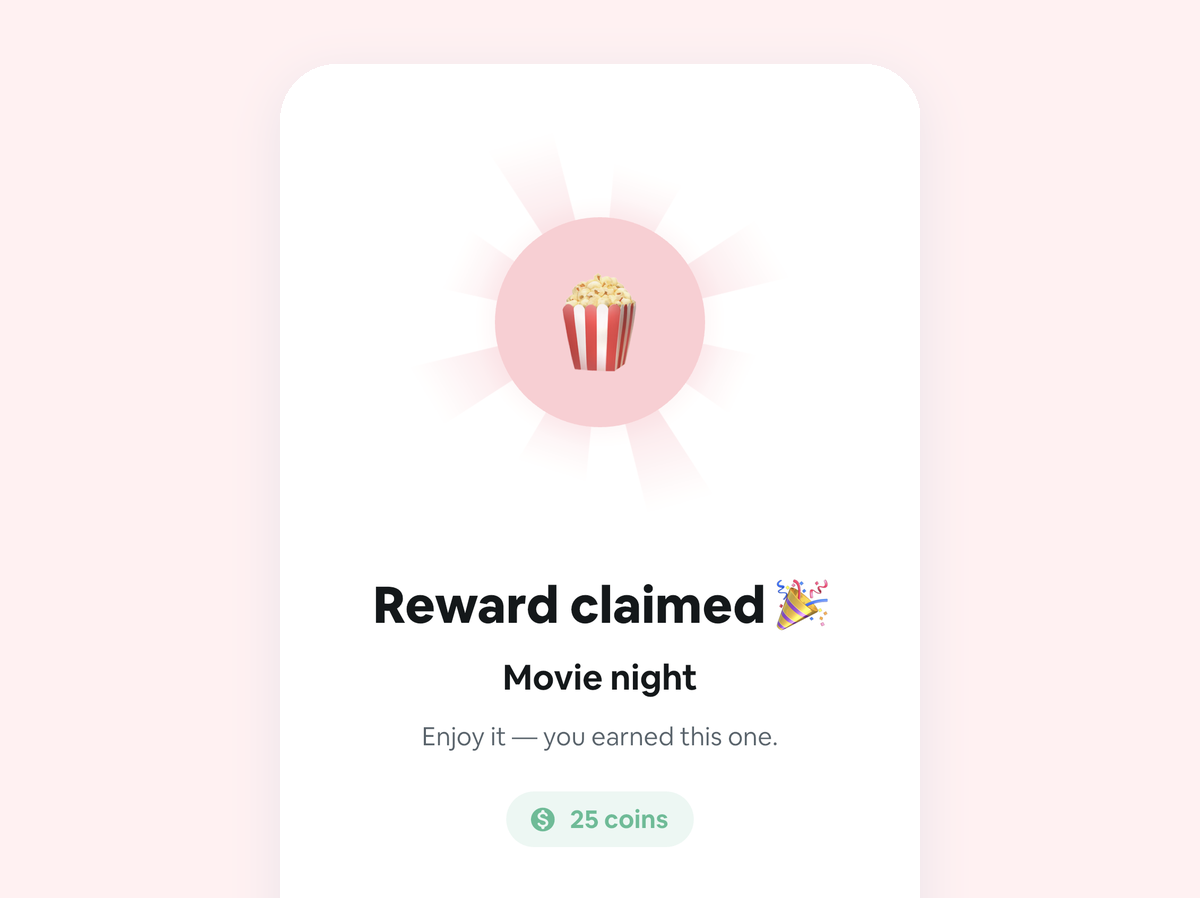
It’s free to download on iPhone and Android.
FAQ
Is a token economy the same as a reward chart? Close. A reward chart usually tracks one goal with stickers toward one prize. A token economy adds a currency: tokens from several behaviors go into one balance, and you choose what to spend it on. Our guide to a reward chart for adults covers the simpler version.
How many tokens should a reward cost? Price it in days of effort. A small reward costs about one good day, a medium one about a good week, and a large one about a month.
Won’t I just cheat? You can, and it’s your system. Clear finish lines for each behavior and a no-credit rule make cheating feel like what it is. If you keep wanting to break a rule, the rule or the prices probably need to change.
Quick recap
- Pick two to four behaviors with clear finish lines.
- Pay more tokens for harder behaviors.
- Price a menu of small, medium and large rewards.
- Buy only what you’ve earned.
- Start without penalties.
- Review weekly and fade habits that run on their own.
✅ Try Habit Rewards App
A simple habit tracker app that helps you build better habits, achieve your goals
- Neat design with beautiful grids
- Visualize your progress at one glance
- Set reminders for your habits
- Customize rewards you desire for your achievements
- Set flexible habits and frequency
- Start now for free
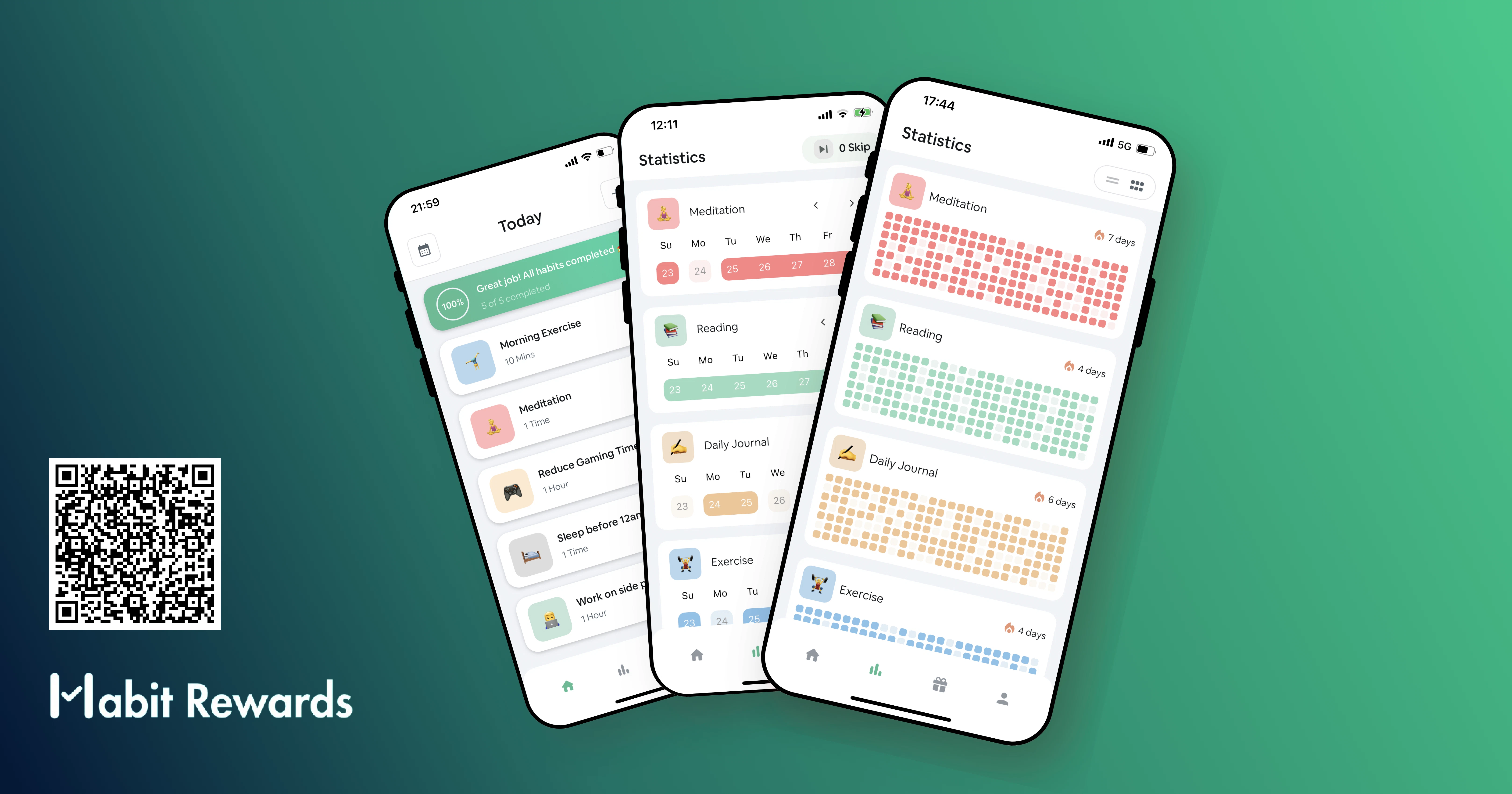
Habit Rewards App is a simple habit tracker with rewards to help your achieve your goals.
Scan the QR code to download from the App Store.

Using Notion?
Build better habits and achieve your goals with this nice Notion Habit Tracker template.
More articles your may be interested in: