
A goal that takes three months pays off in three months. Everything before that is effort with nothing to show for it, and that’s the stretch where most goals die. Rewards fix the gap: they put something good at the end of each stage, not only at the finish line.
This guide covers what makes a goal reward work, a planner that gives each milestone its own reward, and 80 ideas sorted by size and by kind of goal.
What rewards for reaching goals should be
Five rules, in the order they matter:
- Sized to the goal. A weekend away for drinking water three days in a row cheapens both. A coffee for finishing a marathon feels like an insult. Match the reward to the effort it took.
- Soon after the win. The closer the reward is to the moment you hit the milestone, the more your brain links the two. Claim it the same day or that weekend, not “sometime”.
- Decided in advance. Write the reward next to the milestone before you start. A reward chosen afterwards is just a purchase with a story attached.
- On the goal’s side. Rewards that undo the goal (a cake for the weight-loss milestone, a shopping spree for the savings goal) send you backwards. Pick ones that sit next to the goal or feed it: new running shoes for the runner, a book for the reader.
- Something you actually want. “A healthy smoothie” is not a reward if you don’t want it. If you wouldn’t be a little excited to get it, it won’t pull you forward.
Why milestones beat one big prize
Researchers call it the goal-gradient effect: people speed up as a reward gets close. In a 2006 study, Ran Kivetz, Oleg Urminsky and Yuhuang Zheng found that members of a café’s coffee card program bought coffee more often the nearer they got to their free drink. The catch is the long, flat middle of a goal, when the finish is too far away to pull.
Milestones put a finish line inside that middle. Teresa Amabile and Steven Kramer saw the same thing at work: in diaries from hundreds of employees, making progress on meaningful work was the most common event on people’s best days (“The Progress Principle”, 2011). A milestone reward makes that progress visible and gives you something for it.
A milestone reward ladder
Split any goal into five stages and give each a reward. The share of your total reward budget grows as the goal gets harder to finish:
| Milestone | What it marks | Reward size | Share of budget |
|---|---|---|---|
| First step | You started (first workout, first $100 saved) | Small | 5% |
| A quarter | The habit is real, not a plan | Small | 10% |
| Halfway | The slump. This is where people quit | Medium | 20% |
| Three quarters | The finish is in sight | Medium | 15% |
| Finish line | You did it | Big | 50% |
Halfway gets more than three quarters on purpose: the middle is where you need the push most, while the end pulls by itself.
Plan your own here. Enter the goal, dates and what you’d spend on rewards in total:
Milestone reward planner
A goal without a date still works: use the milestone itself (first 5K, 10K, 15K, race day) and skip the dates.
Small rewards for achieving goals (free or under $10)
For the first step and the quarter mark, and for any goal that takes a week or less.
- A long bath or shower with no time limit
- An evening of gaming, guilt-free
- A film you’ve been saving
- A fancy coffee or tea from the good place
- Sleeping in on a weekday you’d normally set an alarm
- Fresh flowers for your desk
- An hour on a hobby with no goal attached
- A new playlist, or an album bought outright
- A walk somewhere new, phone on silent
- A face mask and an early night
- One episode of the show you’d been rationing
- A new pen, notebook or sticker sheet
- A phone call with someone who makes you laugh
- A lazy morning: breakfast in bed, no plans
- A magazine or comic you’d normally skip
- A board-game night with friends
- A favourite snack you don’t usually buy
- A picnic in the park
- Permission to say no to one plan that weekend
- Posting the win somewhere your friends will see it
Medium rewards ($10 to $50)
For the halfway mark and three quarters, or for a goal that took a month.
- A new book, hardback
- A cinema trip with the good seats
- A takeaway from the place you save for special days
- A class: pottery, climbing, a cooking night
- A new game
- A massage or a haircut somewhere nicer than usual
- A plant for the flat
- Tickets to a local gig or comedy night
- A good bottle of olive oil, hot sauce or tea
- A brunch out with a friend
- A museum or gallery day, with lunch
- Nice candles, a throw, a better pillow
- A month of a streaming service you’d cancelled
- A new mug you’ll use every day
- A day trip by train
- Escape-room tickets
- Upgrading one thing you use daily: a better water bottle, headphones case, kitchen knife
- A craft kit or a model set
- A framed print of something you love
- A spa day pass at the local pool or gym
Big rewards (the finish line)
For finishing a goal that took months. Decide this one first: it’s what you’ll picture in the slump.
- A weekend away
- Concert or festival tickets
- New shoes or the jacket you’ve been eyeing
- A gadget: e-reader, smartwatch, speaker
- A course in something you’ve wanted to learn for years
- A nice dinner out, booked in advance
- A day off work with nothing planned
- A piece of furniture that makes home nicer
- A camera or lens
- A trip to see a friend who lives far away
Rewards for achieving fitness goals
Pick rewards that make the next goal easier, not ones you’d need to work off.
- New running shoes once the old pair hits its mileage
- A sports massage after the race
- Better kit: a lighter jacket, a good sports bra, compression socks
- A class pass for something new (climbing, boxing, yoga)
- A fitness tracker or a better pair of headphones for training
- A race entry for the next, bigger distance
For workouts week to week there’s a workout reward chart, and more ideas in how to reward yourself for working out.
Rewards for weight-loss goals (not food)
- Clothes that fit the new you (one piece per milestone, not a whole wardrobe at the end)
- A professional photo shoot at the finish
- A spa day
- New gym gear
- An activity holiday: hiking, surfing, cycling
- Tickets to something you’d have avoided before
Fifty more non-food ideas: how to reward yourself for weight loss, and a printable weight loss reward chart.
Rewards for reading goals
- The next book in the series, hardback
- A bookshop trip with a budget to spend
- A reading light, bookstand or good bookmark
- A literary event or author talk
- A cosy reading afternoon in a café
More in how to reward yourself for reading.
Rewards for saving money goals
The rule here: the reward must cost a small slice of what you saved, or it undoes the goal.
- A nice meal out, about 2 to 5% of what you saved
- Something you’d been putting off buying, paid in cash
- A free day out: hike, beach, museum on a free day
- Moving 10% of the savings to a “fun” pot you’re allowed to spend
- A small upgrade you’ll use daily
If spending is the habit you’re cutting, try No-Spend November.
Rewards for study and career goals
- A day off after the exam, fully planned
- A new laptop bag, desk lamp or keyboard
- A course that’s for fun, not for work
- A celebratory dinner with the people who heard you complain
- A weekend trip after the promotion or the final submission
Week to week: how to reward yourself for studying.
Rewards for sobriety and quitting goals
- Spend what the habit used to cost on something lasting: at 30 days, add it up
- An experience you’d have spent hungover before: an early hike, a morning class
- A milestone token or a piece of jewellery to mark the date
There’s a printable sobriety reward chart and more in how to reward yourself for quitting.
Goals need daily rewards too
Milestones cover the big steps, but most goals are won on ordinary days: the run you didn’t skip, the 20 pages, the $10 you didn’t spend. Those days need a smaller payoff, too, or the gap between milestones gets too long.
The simplest version is a points system: each day’s work earns points, and rewards cost points. Small rewards cost about one good day, medium ones about a week, big ones about a month. The point system for adults has a calculator that prices rewards from what you actually earn, and a reward chart for adults shows how to do it on paper.
Track it in an app
Habit Rewards is a habit tracker built on this idea. Each daily habit pays the coins you give it (1, 4, 8 or 16, or your own number), and one-off tasks pay coins too, so a milestone (“Run 10K”, “Save the first $500”) can be a task worth more coins. You write your rewards with a coin price and claim one when your balance covers it. A Skip costs 10 coins and keeps your streak alive on a day you can’t.
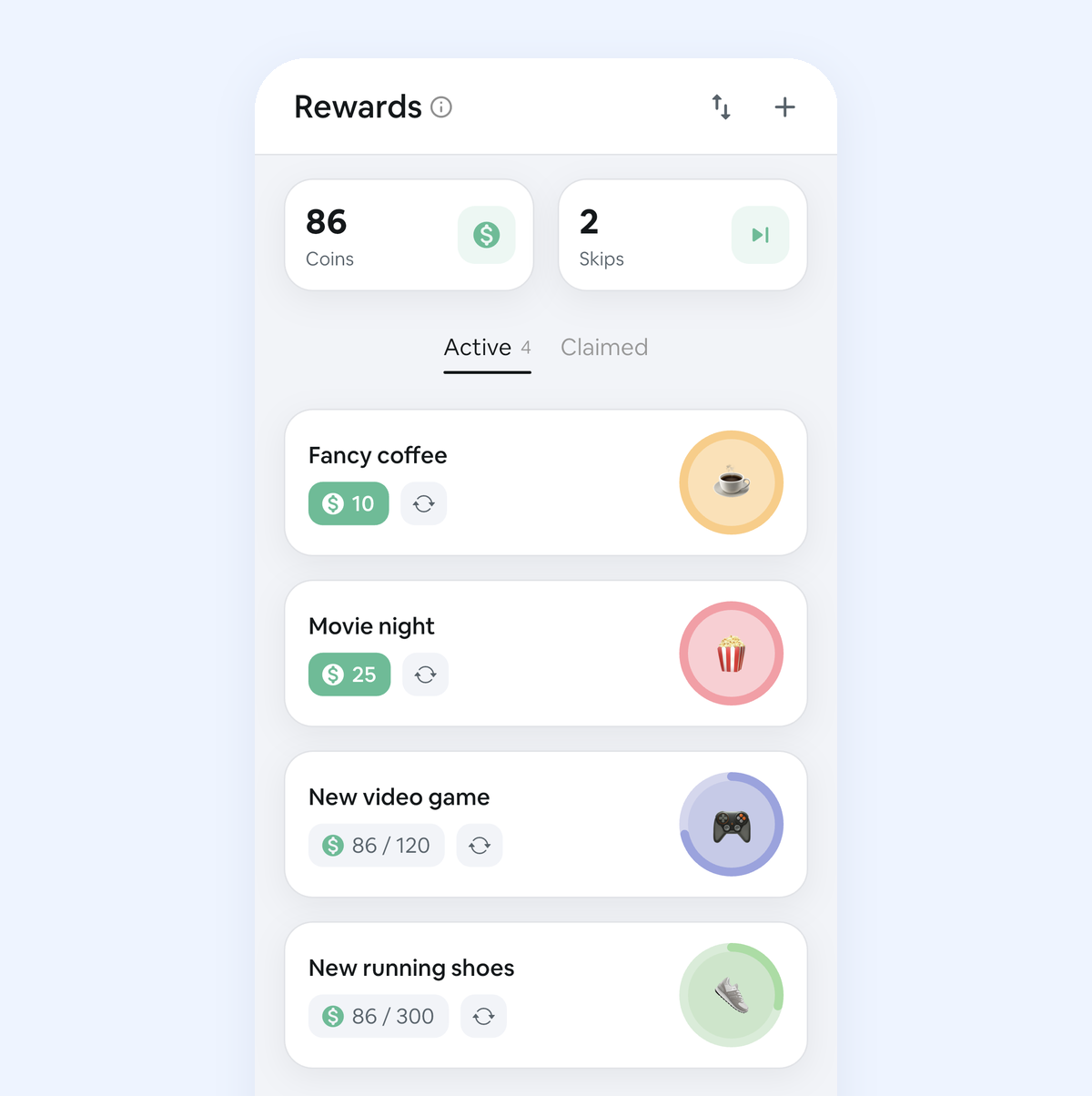
It’s free for three habits and three rewards, and tasks don’t count toward the three, on iPhone and Android.
FAQ
How should you reward yourself for meeting goals? Decide the reward before you start, size it to the goal, and claim it soon after you hit the milestone. For long goals, give each milestone its own reward (first step, a quarter, halfway, three quarters, the finish) rather than one prize at the end.
What are good small rewards for achieving goals? Things you’d enjoy the same day that don’t undo the goal: a long bath, a film, an evening of gaming, a fancy coffee, sleeping in, a walk somewhere new. Keep a list of at least five, so there’s always one you want.
How big should a goal reward be? In proportion to the effort. One way: decide a total reward budget for the whole goal, then give about half to the finish line and split the rest across the milestones, with more at halfway, where people tend to quit.
Should you reward yourself before reaching a goal? Not with the goal’s own reward, or it stops pulling. Reward the milestones on the way, and the daily work with something small, like points toward a reward.
What if I miss the milestone date? Move the date and keep the reward attached to the milestone, not the calendar. Taking the reward anyway teaches you the rule doesn’t matter; dropping the goal because of one missed date wastes everything you did so far.
Do rewards still work once a goal feels easy? You need them less. When the work starts to feel good by itself, lower the rewards or move them to your next, harder goal.
✅ Try Habit Rewards: the habit tracker that pays you
Every habit pays coins by how hard it is (1, 4, 8 or 16). Write your own reward list, put a coin price on each treat, and claim it once you've earned it.
- Daily, weekly and monthly habits, plus one-off tasks that pay coins
- Reminders, streaks and home-screen widgets
- A 10-coin Skip for the days you can't
- Free for three habits, on iPhone and Android
On a computer? Scan the code with your phone (it opens the App Store or Google Play), or get it on the App Store.
Using Notion?
Start with our free Notion habit tracker and formulas, or get the aesthetic Notion Habit Tracker template with heatmaps and streaks.
More articles you may be interested in:
- Free Notion Habit Tracker Templates (and How to Build Your Own)
- Trigger, Behavior, Reward: The Habit Loop Explained With Examples
- How to Reward Yourself Without Spending Money (and for Saving It)
- How to Reward Yourself for Hard Work: 50 Ideas by Effort
- Workout Reward Chart for Adults: Free Printable 100-Workout Chart
- Weight Loss Reward Chart: Free Printable and Reward Ideas for Every Milestone
Rather track it on your phone? In Habit Rewards every check-off earns coins, and you spend them on rewards you set yourself. Free on iPhone and Android for up to 3 habits.
Get the appFree habit tools and printables
Free, in your browser, no sign-up.