
Hard work has a strange way of not feeling like anything. You finish the report, ship the project, get through the week from hell, and the next thing on the list is already waiting. No finish line, no moment that says “that counted”.
Rewarding yourself gives the work an ending. It also teaches your brain that effort pays, which makes the next push easier to start. The trick is to size the reward to the effort and pick ones that don’t steal from tomorrow.
Five rules for rewarding hard work
- Size it to the effort. A focused hour gets five minutes of something nice; a brutal month gets a day off or a trip. If every small push earns a big treat, the big pushes stop feeling special.
- Reward the finish, not the hours. “Worked ten hours” is easy to fake and easy to burn out on. “Sent the proposal”, “cleared the inbox”, “finished the chapter” are wins you can see. Reward those.
- Don’t let the reward cost tomorrow. The usual ones (staying up late, a few drinks too many, an evening of scrolling, a splurge) feel like rewards tonight and like punishment in the morning. Pick rewards you’ll still be glad about the next day.
- Leave the work behind. A reward eaten at your desk with the laptop open doesn’t count. Step away, close the tabs, change rooms. The break is half the reward.
- Mark it. Cross it off, tell someone, write it down. A win nobody notices, including you, fades fast.
Rewards after a focused hour
Small and quick, so you can get back to it:
- Five minutes outside, no phone
- A proper coffee or tea, made slowly
- One song, loud
- A stretch or a short walk around the block
- A few minutes of a game or a puzzle, with a timer
- A message to a friend
- A snack you like, away from the desk
- Standing at a window doing nothing for a minute
- Reading one article you’d saved
- Ticking the block off where you can see it
Rewards after a long day
The goal is to switch off, not to keep going on a different screen:
- A long shower or a bath
- Your favourite takeaway, eaten at the table
- An episode of the show you’re saving, then bed
- A walk with a podcast
- Cooking something you enjoy, music on
- An early night with a book
- A call with someone who makes you laugh
- An hour of a game you love
- Changing into the comfy clothes as soon as you’re home
- Writing the three things you got done, then closing the laptop
Rewards after a hard week
- A lazy Saturday morning with no alarm
- Brunch out with a friend
- A cinema trip
- A massage
- A day trip somewhere you’ve never been
- A new book or game
- A class you’ve wanted to try
- An afternoon on a hobby with no goal
- A long walk or hike, then a good lunch
- A weekend with no work email at all
Rewards for a job well done (a finished project)
The big ones. Decide them when the project starts, so they pull you through the middle:
- A day off, fully planned around what you love
- A weekend away
- Concert or show tickets
- A gadget you’ve wanted for months
- A really good dinner out
- A course that’s just for you
- New shoes, a jacket, a bag you’ll use every day
- A spa day
- A piece of art or a print for your space
- A celebration with the people who helped, or who put up with you during it
Rewards that cost nothing
For any of the above, when money is the thing you’re working for:
- Sleeping in
- A nap in the afternoon
- A whole evening with no plans
- A library haul
- A free museum day
- A board-game night at home
- A picnic in the park
- Doing nothing, on purpose, for an hour
- A movie you already own
- Telling someone what you pulled off
Sixty more in how to reward yourself without spending money.
How to reward yourself for being productive
Productivity is a hundred small wins a day, too many to reward one by one. Two ways that work:
Earned breaks. The Pomodoro Technique, created by Francesco Cirillo, uses 25 minutes of focus followed by a 5-minute break, and a longer break after four rounds. The breaks are the reward: you only get one when the block is done, and the longer one feels earned. Use them for the “focused hour” ideas above.
Points for finished work. Give your work points by difficulty and spend them on rewards:
| Finished | Points |
|---|---|
| A small task you’d been avoiding (an email, a call) | 1 |
| A focused block of work | 4 |
| A hard task, start to finish | 8 |
| A big deliverable shipped | 16 |
A solid day earns around 25 points. Price rewards in days of effort: a takeaway at about 25, a cinema trip at about a week’s points, a weekend away at about a month’s. The point system for adults has a calculator that prices rewards from what you actually earn.
When hard work isn’t the problem
If you’re working hard every day and still never feel done, more rewards won’t fix it. Look at the list instead: fewer things, each with a clear finish, gives you more moments that feel like a win. How to reward yourself for completing tasks covers the to-do side, and gamified to-do list apps score it for you. For long projects, give each milestone its own reward: rewards for achieving goals has a planner.
Track it in an app
Habit Rewards does the counting. Daily work like “2 hours of deep work” or “inbox to zero” can be a habit, and one-off jobs (“Send the proposal”) can be tasks. Each pays the coins you give it (1, 4, 8 or 16, or your own number) into one balance. You write your rewards with a coin price and claim one when your balance covers it, so the reward is always earned.
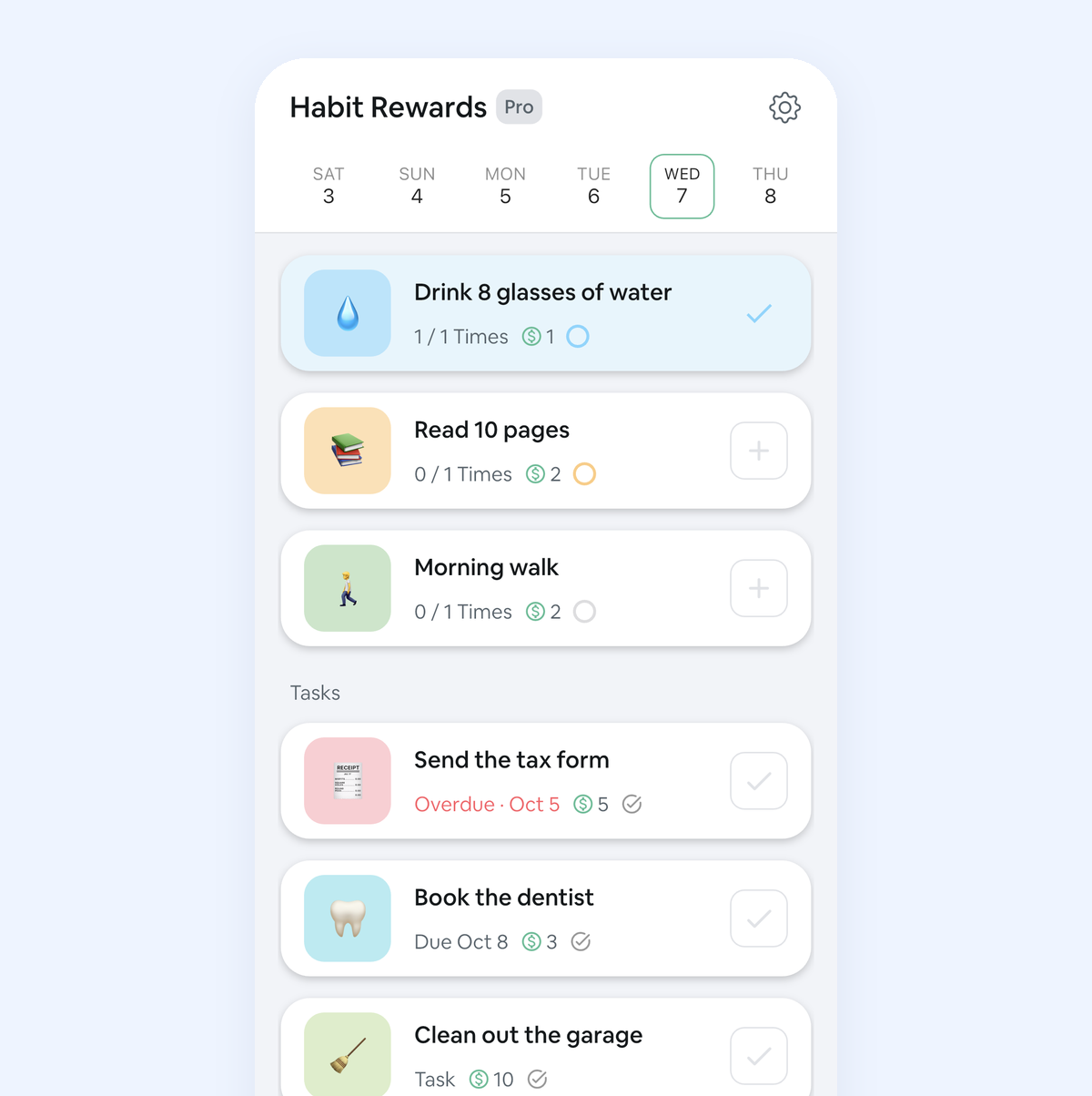
It’s free for three habits and three rewards, and tasks don’t count toward the three, on iPhone and Android.
FAQ
How do I reward myself after a long day at work? Pick something that helps you switch off rather than keeps you on a screen: a long shower, a walk, your favourite dinner at the table, one episode and an early night. Close the laptop first, so the reward isn’t half work.
What’s a good reward for a job well done? Something sized to the project: a day off, a weekend away, tickets to a show, a dinner out, or a thing you’ve wanted for months. Decide it at the start of the project so it pulls you through the middle.
How do I reward myself for being productive without wasting time? Use rewards with a built-in end: a 5-minute break after a 25-minute block, one song, one episode, a walk around the block. Avoid open-ended ones like scrolling, which tend to eat more time than the work took.
Should I reward myself for working long hours? Reward what you finished, not the hours. Long hours without a clear win are often a sign of a list that’s too long, and rewarding the hours just makes burnout feel productive.
What if I don’t feel I deserve a reward? Decide the rules in advance (“when the report is sent, I get the evening off”) and follow them, whatever your mood says. A rule you set when you were calm is fairer than a judgment made when you’re tired.
✅ Try Habit Rewards: the habit tracker that pays you
Every habit pays coins by how hard it is (1, 4, 8 or 16). Write your own reward list, put a coin price on each treat, and claim it once you've earned it.
- Daily, weekly and monthly habits, plus one-off tasks that pay coins
- Reminders, streaks and home-screen widgets
- A 10-coin Skip for the days you can't
- Free for three habits, on iPhone and Android
On a computer? Scan the code with your phone (it opens the App Store or Google Play), or get it on the App Store.
Using Notion?
Start with our free Notion habit tracker and formulas, or get the aesthetic Notion Habit Tracker template with heatmaps and streaks.
More articles you may be interested in:
- Free Notion Habit Tracker Templates (and How to Build Your Own)
- Trigger, Behavior, Reward: The Habit Loop Explained With Examples
- Rewards for Achieving Goals: 80 Ideas, Sized to the Goal
- How to Reward Yourself Without Spending Money (and for Saving It)
- Workout Reward Chart for Adults: Free Printable 100-Workout Chart
- Weight Loss Reward Chart: Free Printable and Reward Ideas for Every Milestone
Rather track it on your phone? In Habit Rewards every check-off earns coins, and you spend them on rewards you set yourself. Free on iPhone and Android for up to 3 habits.
Get the appFree habit tools and printables
Free, in your browser, no sign-up.