
Building a habit and quitting one feel similar, but they work the other way round. A new habit gives you something to do. Quitting gives you something not to do, and nothing happens when you manage it. No box to tick, no buzz, no proof. Meanwhile the habit you’re quitting still pays out instantly every time you give in.
That’s the gap a reward fills. If not doing the thing earns something you can see and spend, every day you hold out counts for something.
1. Fund the rewards with what the habit cost
Most habits people quit cost money: drinks, cigarettes, vapes, takeaway, impulse buys. That money is your reward budget.
Work out what the habit costs in a normal week and divide by seven. That’s what each day off is worth.
| Habit | A normal week | Each day off is worth |
|---|---|---|
| Drinks out and at home | $56 | $8 |
| A pack every two days | $49 | $7 |
| Vape pods | $21 | $3 |
| Takeaway coffee and snacks | $35 | $5 |
Put that amount aside every day you keep to it: a jar, a separate savings account, or just a running total on paper. Then spend part of it on rewards. The money was going to disappear anyway; now it buys you something you want, and you can see what quitting is worth.
Not everything costs money. Doomscrolling, snoozing or late nights don’t. For those, pay yourself in points instead: each day off earns, say, 10 points, and rewards cost points (more on that below).
2. Put the first rewards close together
The first days are the hardest, and a reward on day 30 is too far off to help on day 2. So front-load the ladder:
| Milestone | Reward size |
|---|---|
| Day 1 | Small: a fancy coffee, a film at home |
| Day 3 | Small |
| Day 7 | Medium: a meal out, a book, a class |
| Day 14 | Medium |
| Day 30 | Big: what you’ve been wanting for a while |
| Day 60, 90 | Big, paid for by the money kept |
| Day 180, 365 | The one you’d never normally let yourself have |
With the $8-a-day example, day 30 has put $240 aside, and day 90 about $720. A weekend away stops being a splurge when it’s paid for by drinks you didn’t buy.
3. Pick rewards that don’t lead back to the habit
A reward should pull you away from the habit, not towards it:
- Not the habit in disguise. “One drink to celebrate a week off” is a relapse with a party hat. So is a cigar for a month off smoking.
- Not the setting. If the habit lives in the pub, a reward night in the pub is a test you didn’t need to set yourself. Pick a cinema, a restaurant, a match.
- Something for the new you. Running shoes for the mornings you’re no longer hungover. A good pillow for the nights you’re not scrolling. Better coffee for the breaks you used to smoke on.
- Something for the bad moments. Keep a short list of small, free rewards for the evenings when the urge hits: a bath, a walk, a call with a friend, an episode of something. A dopamine menu is a ready-made list of them.
More ideas in 70 ways to reward yourself.
4. Decide what a slip means before it happens
Slips are common when you quit something. What hurts is deciding afterwards, in the worst mood, that the whole attempt is ruined.
Decide now instead. Two rules that work:
- Mark it and carry on. A slip costs you that day’s money or points, nothing more. You don’t lose what you’ve already earned.
- Never twice in a row. One slip is a day. Two in a row is the habit coming back, so the day after a slip matters more than any other.
Counting the days you did manage also helps. “27 of the last 30 days” is more honest, and more motivating, than a counter that went back to zero.
5. If it’s drinking or smoking, get support too
Rewards help you stick to a decision. They don’t replace medical help:
- Heavy daily drinking: stopping suddenly can cause withdrawal, which can be dangerous. Talk to a doctor before you stop.
- Smoking and vaping: nicotine replacement and quit services make quitting more likely to last. Ask a doctor or pharmacist, or call your country’s quitline.
Quitting one month at a time
If quitting for good feels too big, start with a month. Our free Dry January tracker prints a box for every day, puts rewards on day 7, 14, 21 and 31, and shows the money you’ve kept by each one. It works for Sober October or any other month too, and for any habit, not just alcohol: change the title.
Track it on your phone
Habit Rewards is a habit tracker for iPhone and Android with a “Quit a habit” mode. Each day you stay on track pays coins. If you slip, you can mark the day as failed, and it costs coins instead. You spend the coins on rewards you set yourself, from a coffee to a weekend away, and it keeps the streak and sends a reminder.
✅ Try Habit Rewards App
A simple habit tracker app that helps you build better habits, achieve your goals
- Neat design with beautiful grids
- Visualize your progress at one glance
- Set reminders for your habits
- Customize rewards you desire for your achievements
- Set flexible habits and frequency
- Start now for free
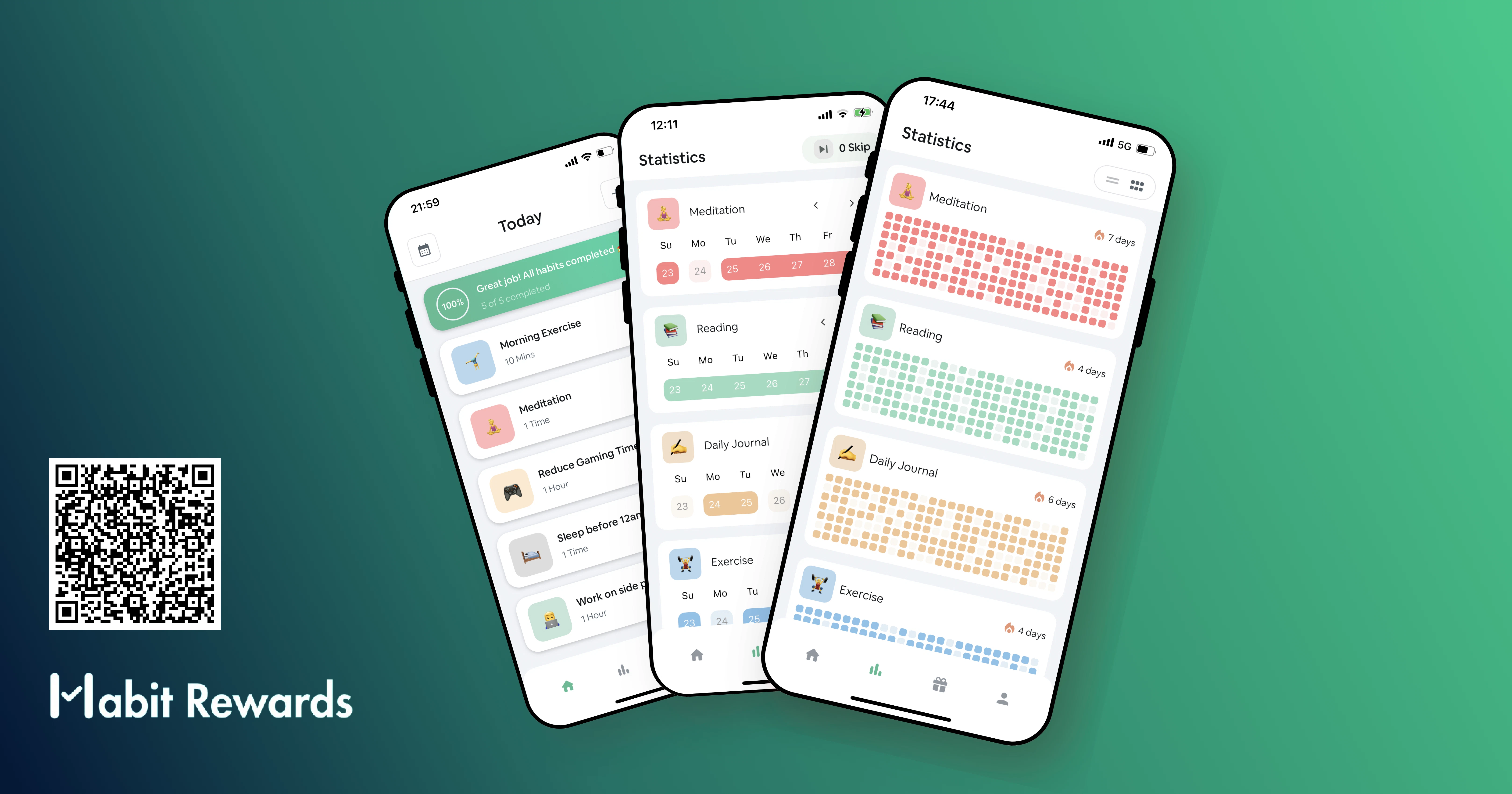
Habit Rewards App is a simple habit tracker with rewards to help your achieve your goals.
Scan the QR code to download from the App Store.

Using Notion?
Build better habits and achieve your goals with this nice Notion Habit Tracker template.
More articles you may be interested in:
Free habit tools and printables
Free, in your browser, no sign-up.