
Routinery is a routine app for the parts of the day that happen in the same order every time. You stack small habits into a routine (a morning, a wind-down, a study block), split it into steps of one to five minutes, and each step runs on its own timer while a voice tells you what’s next. Apple made it an App of the Day, it’s rated 4.7 from about 18,000 US App Store ratings, and it’s especially popular with adults with ADHD who know what to do but struggle to start.
Here’s what you get for free, what Premium adds and costs, and four alternatives for when it isn’t the right fit. One of them is ours, Habit Rewards; we’ve tried to describe the others fairly.
Routinery free vs Premium
| Free | Premium | |
|---|---|---|
| Routines | 2 | no cap |
| Step timers, voice, reminders | yes | yes |
| Ads | yes | no |
| Account needed | no | no |
Routinery says so in its own listing: two routines free, no account, and Premium “lifts the routine cap” and removes the ads. Two routines (say, a morning and an evening one) is enough to find out whether the timer-and-voice approach works for you before you pay.
How much does Routinery cost?
On the US App Store, Premium is listed at $36.00 a year (also $39.49), $5.00 or $5.49 a month, $24.00 for six months and $12.49 for three, plus a $0.99 weekly plan and a $24.00 “Plus” yearly plan (we read the list on October 24, 2026). The paywall in the app shows which one applies to you. That puts the yearly plan a little above the typical habit app, which is about $30 a year (prices compared).
Is Routinery on Android?
No. Routinery runs on iPhone, iPad, Mac and Apple Watch, and there’s no web version. If you’re on Android, or share routines with someone who is, all four apps below run on Android.
| If you want… | Try |
|---|---|
| The whole day on one visual timeline, mostly free | Structured |
| A calm visual planner made for ADHD brains | Tiimo |
| A guided program that builds a routine for you | Fabulous |
| A reward for getting through the routine | Habit Rewards |
1. Structured: the day as a timeline
Structured lays tasks, events and routines out on one visual timeline, so you can see how the day fits together. The free version is generous: the drag-and-drop timeline, an inbox for quick ideas, subtasks, a focus timer and widgets. Pro adds calendar sync, recurring tasks and routines, and moving the tasks you missed. It’s rated 4.8 from about 168,000 US ratings and runs on iPhone, iPad, Apple Watch, Mac and Android.
Good for: people who want to plan the whole day, not just its routines.
Less good if: what you need is something to walk you through each step. Structured shows the plan; it doesn’t run it with you.
2. Tiimo: a calm visual planner
Tiimo, Apple’s iPhone App of the Year for 2025, is a visual planner built with neurodivergent people in mind: a colour-coded schedule you rearrange by dragging, a to-do list to brain-dump into, a countdown timer and widgets that keep the next thing in view. It’s rated 4.6 from more than 21,000 US ratings and runs on iPhone, Android and the web. Pro is a subscription; the App Store lists prices from $7.00 to $54.00 (Tiimo alternatives).
Good for: people who want Routinery’s ADHD-friendly calm across their whole day, on any device.
Less good if: you only want routines; it’s a full planner.
3. Fabulous: a coach that builds the routine for you
Fabulous starts you on a guided journey: one small habit (drink a glass of water when you wake up), then another, until you have a morning routine. Around that it adds daily coaching, journaling, short workouts and meditation. It’s rated 4.4 from about 89,000 US ratings, on iPhone and Android, and Premium is a subscription ($49.99 a year among the listed prices; Fabulous alternatives).
Good for: people who don’t know where to start and want a program to follow.
Less good if: you already know your routine and just need to get through it.
4. Habit Rewards: a reward for getting through it
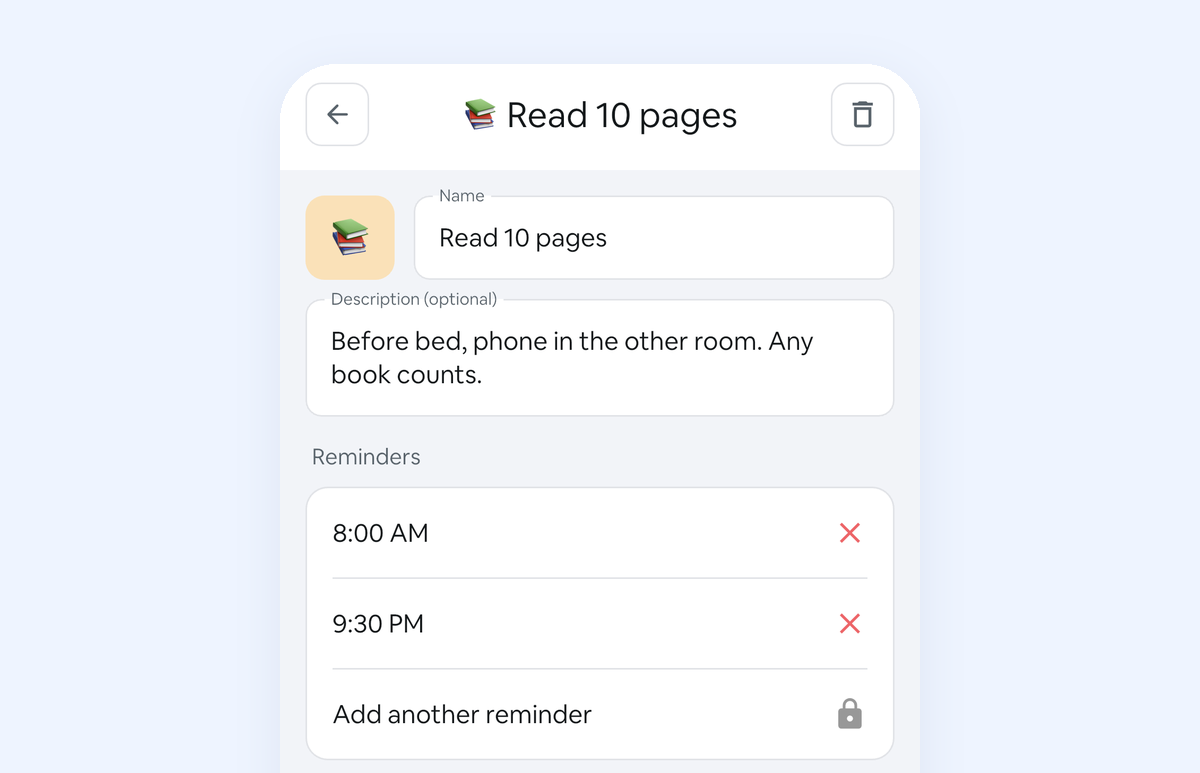
This one’s ours, and it doesn’t run timers. It’s for the other half of the problem: wanting to do the routine at all. Every habit pays coins by how hard it is (1, 4, 8 or 16), so a whole morning routine can add up, and one-off to-dos go in as tasks that pay coins too. You write your own rewards, like a coffee out, an episode of your show or an afternoon off, each with a coin price, and claim one when your balance covers it. Reminders, a streak and a done/skipped/failed calendar come with every habit, and on a day you can’t manage, a Skip costs 10 coins and keeps the streak alive.
It’s on iPhone and Android, free for three habits and three rewards (tasks don’t count toward the three), with free home-screen widgets. Pro removes the limits.
Good for: people who can plan a routine but lose the will to keep it, and anyone who already bribes themselves with treats.
Less good if: you want step timers and a voice guiding you. Routinery does that better; the two work well together.
Which one?
If Routinery works for you and two routines are enough, the free plan is fine as it is. If you need more, $36 a year is fair for what it does. If you’re on Android, or Routinery isn’t quite it, ask where the day falls apart. Not knowing what’s next: Structured or Tiimo. Not knowing where to start: Fabulous. Knowing exactly what to do and not wanting to: put a reward at the end of it with Habit Rewards.
FAQ
Is Routinery free?
Yes, for two routines, with ads and no account. Premium removes the cap and the ads.
Is Routinery worth it?
If timed, voice-guided steps get you moving, yes: it’s the best-known app that does exactly that. Try the two free routines for a week before paying.
Routinery vs Tiimo: which is better for ADHD?
They solve different problems. Routinery runs a fixed routine with you, step by step. Tiimo plans the whole day visually, routines and one-off tasks together, and it runs on Android and the web, which Routinery doesn’t.
Routinery vs Structured?
Structured plans your day on a timeline and is mostly free; Routinery runs your routines with timers and a voice. Plenty of people use Structured for the day and Routinery for the morning.
Is there a free routine planner online?
Our free habit and reward tools run in the browser with no sign-up, including a printable habit tracker and a habit stacking template.
More comparisons: Me+ alternatives, apps like Finch and the best habit tracker apps, grouped by what motivates you.
Habit Rewards is free on iPhone and Android. Routinery is a product of Routinery Corp.; we’re not affiliated with it or with the other apps mentioned. Features and prices change, so check each app’s listing before you buy.
✅ Try Habit Rewards: the habit tracker that pays you
Every habit pays coins by how hard it is (1, 4, 8 or 16). Write your own reward list, put a coin price on each treat, and claim it once you've earned it.
- Daily, weekly and monthly habits, plus one-off tasks that pay coins
- Reminders, streaks and home-screen widgets
- A 10-coin Skip for the days you can't
- Free for three habits, on iPhone and Android

On a computer? Scan the code with your phone (it opens the App Store or Google Play), or get it on the App Store.

Using Notion?
Start with our free Notion habit tracker and formulas, or get the aesthetic Notion Habit Tracker template with heatmaps and streaks.
More articles you may be interested in:
- Free Notion Habit Tracker Templates (and How to Build Your Own)
- Trigger, Behavior, Reward: The Habit Loop Explained With Examples
- Streaks App Alternatives: Is Streaks Worth $5.99, and 4 Free Picks for iPhone
- Productive Habit Tracker: Free vs Premium, Pricing, and 4 Alternatives
- November Gratitude Challenge 2026: 30 Prompts, One a Day (+ a Version for Kids)
- No Spend November 2026: Rules, a Day-by-Day Calendar and a Free Tracker
Rather track it on your phone? In Habit Rewards every check-off earns coins, and you spend them on rewards you set yourself. Free on iPhone and Android for up to 3 habits.
Get the appFree habit tools and printables
Free, in your browser, no sign-up.