
Some tasks you’ll do anyway. The ones that sit on your list for three weeks are different: renewing the passport, the expense report, the email you’ve been avoiding. They aren’t hard. They just offer nothing back, and anything else you could be doing offers something right now.
A reward gives those tasks something to offer. Here’s how to set one up so it works on the tasks that need it, and doesn’t turn into an excuse to stop.
1. Price tasks by dread, not by size
The task that takes ten minutes but makes your stomach drop is worth more than the one that takes an hour and feels fine. Pay for the dread.
| Task | Points |
|---|---|
| Reply to an email you’ve been avoiding | 8 |
| Book the dentist | 8 |
| Call the bank / insurer / landlord | 16 |
| Do the expense report or the tax form | 16 |
| Clear the inbox to zero | 8 |
| Finish one section of the big project | 16 |
| Tidy the desk | 4 |
| Return the parcel | 4 |
| Pay a bill | 1 |
Four fixed levels (1, 4, 8, 16) are enough. You decide in a second, and the scale makes the worst job on the list worth four times a medium one.
2. Put the fun after the work (first-then)
The simplest rule: first the task, then the thing you wanted to do anyway. Psychologists call this the Premack principle: a behaviour you’d happily do can reward one you wouldn’t. It’s how “homework, then TV” works for kids, and it works for adults with “expense report, then the next episode”.
The trick is to decide the pair in advance. “After I send the report, I’ll make a proper coffee” is a plan. “I’ll get coffee and then do the report” is the coffee.
3. Reward starting, or reward finishing: pick the one you need
There are two ways to get stuck on a task, and they need different rewards.
- You never start. Reward the start. Set a timer for 10 minutes; when it rings, you’ve earned the points, whatever you got done. Starting is the hard part, and most days you’ll keep going.
- You start and drift off. Reward the finish. Only a sent email, a submitted form or a closed ticket counts. Write down what “done” looks like before you begin.
4. Pick rewards that end
The most common reward for finishing a task is the worst one: “I’ll just check my phone.” It has no end, so the reward eats the afternoon and the next task never starts.
Good task rewards have a built-in finish:
- Small (1–8 points): a coffee, one episode, a walk round the block, a song you love at full volume, 15 minutes of a game with a timer
- Medium (20–50 points): a takeaway lunch, a film, a new book, an afternoon off the to-do list
- Big (100+ points): the thing you’ve been wanting to buy, a day trip, a massage
If you’re stuck for ideas, here are 70 ways to reward yourself, sorted by cost, and a dopamine menu is a ready-made list of small ones.
5. Batch the small stuff
Ten tiny tasks don’t each need a reward. Group them: “phone calls hour” or “life admin Sunday”, and pay one bigger reward when the batch is done. It also stops you spending the day on the easiest items because each one feels like a win.
6. Bigger goals get milestone rewards
Rewarding a task works for things you finish in a day. A goal that takes months, like writing a thesis, getting fit or learning a language, needs rewards along the way. Break it into milestones you’d recognise (first chapter drafted, first 5K, first 30 days) and give each one its own reward. Small and frequent early, when you haven’t seen any results yet, bigger later.
For the daily part of a big goal, habit stacking helps the work happen at the same time every day.
Track it on your phone
Habit Rewards does the counting for you. Tap + on the home screen, choose Create a task, and give it a coin value (1, 4, 8 or 16, or your own number), and if you like a due date and a reminder. When you check it off, the coins go to the same balance as your daily habits. You write your rewards and give each a coin price, and claim one when your balance covers it.
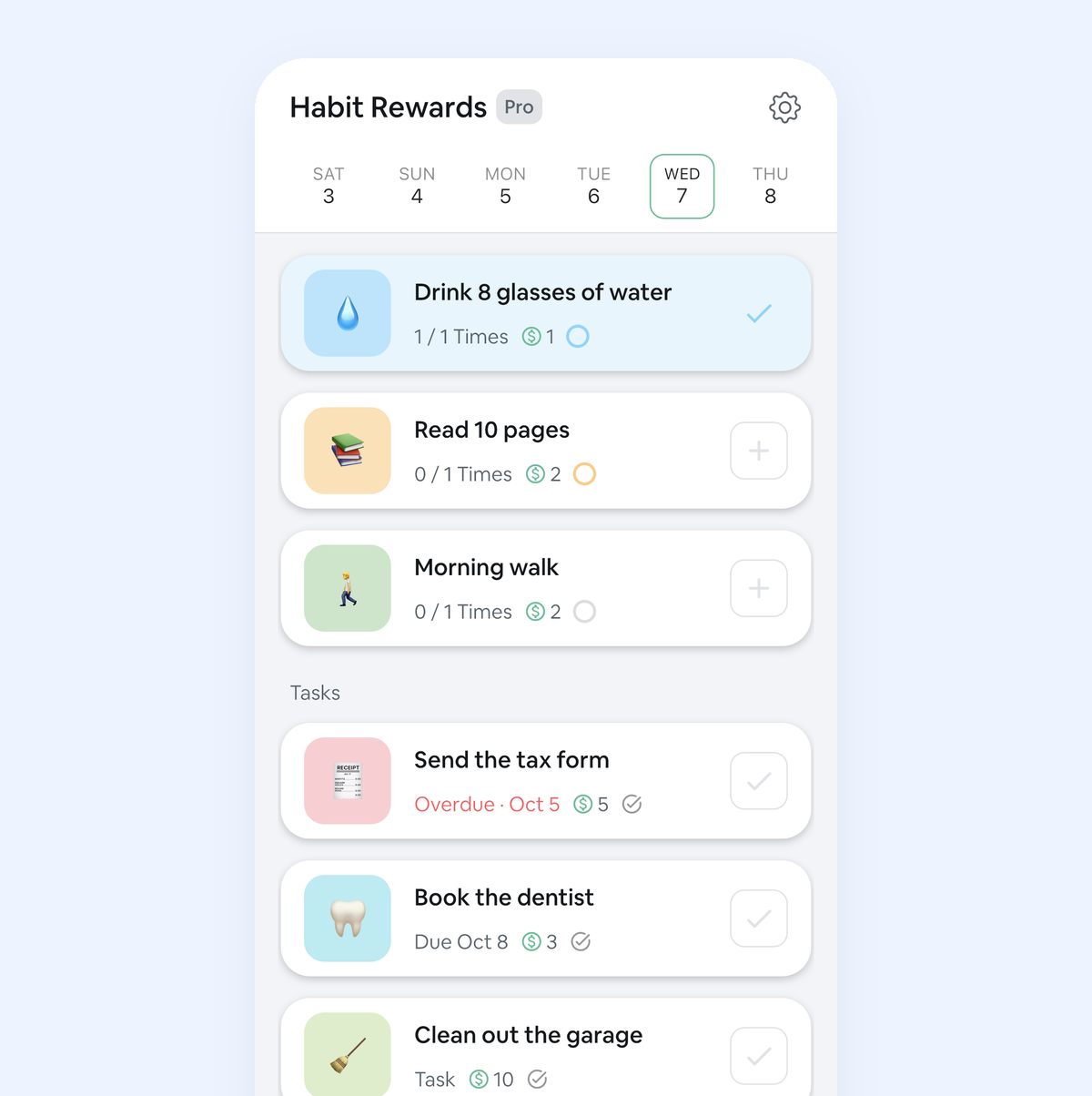
Tasks don’t count toward the free plan’s three habits, so you can try it for free on iPhone and Android. More on scoring a to-do list in gamified to-do list apps.
FAQ
How do I reward myself for completing tasks without losing the whole day? Choose rewards that end on their own: a coffee, one episode, a walk, a game with a timer. Avoid open-ended ones like “check my phone”, which have no stopping point.
Should I reward every task? No. Reward the ones you avoid. Tasks you’d do anyway don’t need a payoff, and small ones work better batched: one reward for the whole batch.
How do I reward myself for meeting goals? Break the goal into milestones and give each a reward, small and frequent early on, bigger later. For the daily work behind it, use points per task or per habit and save them toward the milestone rewards.
What is the Premack principle? The idea that a behaviour you’d happily do can reward one you’d rather avoid, if the fun one comes after. It’s named after psychologist David Premack, who described it in 1959. In practice: first the task, then the treat.
Does rewarding yourself for tasks work with ADHD? Many people with ADHD find a quick, visible payoff makes starting easier, so rewarding the start (10 minutes, then the points) tends to work better than rewarding the finish. It’s a planning trick, not a treatment. More in our ADHD habit tracker guide.
✅ Try Habit Rewards: the habit tracker that pays you
Every habit pays coins by how hard it is (1, 4, 8 or 16). Write your own reward list, put a coin price on each treat, and claim it once you've earned it.
- Daily, weekly and monthly habits, plus one-off tasks that pay coins
- Reminders, streaks and home-screen widgets
- A 10-coin Skip for the days you can't
- Free for three habits, on iPhone and Android
On a computer? Scan the code with your phone (it opens the App Store or Google Play), or get it on the App Store.

Using Notion?
Start with our free Notion habit tracker and formulas, or get the aesthetic Notion Habit Tracker template with heatmaps and streaks.
More articles you may be interested in:
- Free Notion Habit Tracker Templates (and How to Build Your Own)
- Trigger, Behavior, Reward: The Habit Loop Explained With Examples
- Reward Jar Ideas for Adults: How to Set One Up (+ 40 Slips)
- 50 Realistic New Year's Resolutions for 2027 (and the Daily Habit for Each)
- New Year's Resolution Tracker: How to Keep Track of Your 2027 Resolutions
- How to Wake Up Early (and Make It a Habit That Sticks)
Free habit tools and printables
Free, in your browser, no sign-up.