
Most resolutions don’t fail on January 1st. They fade somewhere in February, quietly, because nothing in your day asks about them. A resolution like “get fit” or “read more” has no moment when you either did it or didn’t.
A tracker gives it one. Here’s how to set one up so it’s still running in June.
Do resolutions work at all?
More often than their reputation suggests. In a 2002 study by John Norcross and colleagues, 46% of people who made a New Year’s resolution were still on track six months later. Among people who wanted the same change but didn’t make a resolution, it was 4%.
So deciding counts. What decides the rest is the daily part: whether the resolution turns into something you do on a normal Tuesday.
Step 1: Turn each resolution into a habit you can check off
A resolution is a direction. A habit is the thing you check off today. For each resolution, pick one small action you could do on your worst day:
| Resolution | Habit to track |
|---|---|
| Get fit | A 20-minute walk, or a workout three days a week |
| Read more | 10 pages before bed |
| Eat better | Cook dinner at home |
| Save money | No takeout on weekdays, or move $5 to savings |
| Less phone | Phone out of the bedroom by 10 pm |
| Learn a language | One lesson a day |
| Sleep better | Lights out by 11 |
| Drink less | Alcohol-free days (count them) |
Keep it to three resolutions, four at most. Every extra habit makes the others less likely. Need more ideas? Here are 50 realistic resolutions, each with its daily habit.
Step 2: Write it as something to do
In a 2020 study in PLOS ONE (Oscarsson and colleagues, about 1,000 people), resolutions phrased as something to do (“walk every day”) succeeded more often after a year than ones phrased as something to avoid (“stop sitting so much”): 59% against 47%.
So “eat less sugar” becomes “fruit after dinner”. “Stop scrolling” becomes “read 10 pages in bed”. When the resolution really is a quit, like smoking, drinking or vaping, track the days you go without and celebrate the count. Doing Dry January? Our free Dry January tracker counts the days and the money you save. More on rewarding yourself for quitting.
Step 3: Track it every day, where you’ll see it
The tracker matters less than looking at it daily. Three options:
- An app. Reminders at the time you planned, a streak you don’t want to break, and a history you can’t fudge. Best if your phone is always with you.
- Paper. A printed sheet on the fridge or by the bed. Our free yearly habit tracker for 2027 gives each habit a page with 365 days, a monthly goal and reward, and one big reward for the year. For a lighter start, the 30-day challenge tracker covers January alone.
- A spreadsheet. Fine if you live in one at work. Least likely to get checked on a weekend.
Whichever you pick, mark the day the moment you’ve done the habit, not at night from memory.
Step 4: Pay yourself for the days you keep it
Resolutions pay off in months: the fitness, the savings, the finished books. Your brain wants something sooner. Give it a small, planned reward for each day you keep a resolution, and bigger ones at milestones:
- Points per check-in. An easy habit earns 1 point, a hard one 8 or 16.
- A reward menu. A coffee out for 10 points, a movie night for 25, new running shoes for 300. You pick the prices.
- Milestones. Something special at day 7, day 30, day 100 and at the end of the year.
Not sure what to put on the menu? Here are 70 ways to reward yourself, with ideas by size.
Step 5: Plan for the bad week now
It will come: a cold, a work trip, the holidays you forgot about. Decide today what happens then:
- Shrink the habit, don’t skip it. Five minutes of walking still counts.
- Never miss twice. One missed day is noise. Two in a row is the start of a new habit.
- Restart on Monday, not next January. Pick a new start day as soon as you notice.
What to look for in a resolution tracker app
Most habit trackers check off a habit and keep a streak. For resolutions, look for:
- Reminders at the time you planned to do the habit.
- Flexible schedules, so “three workouts a week” doesn’t break your streak on rest days.
- A quit mode for resolutions that are about stopping something, so the days you go without count.
- A widget, so you check off from your home screen without opening the app.
- Rewards, so keeping a resolution pays something this week, not just next year.
- A free tier that covers three habits, because three resolutions is plenty.
Do it in Habit Rewards
Habit Rewards is a habit tracker built around Step 4. Add a habit for each resolution, choose the days it repeats and set a reminder. Each check-in pays 1, 4, 8 or 16 coins depending on how hard you rate it. Your rewards each have a coin price, and you claim one when your balance covers it. A “Quit a habit” mode pays coins for each day you stay on track, and home-screen widgets on iPhone and Android let you check off without opening the app.
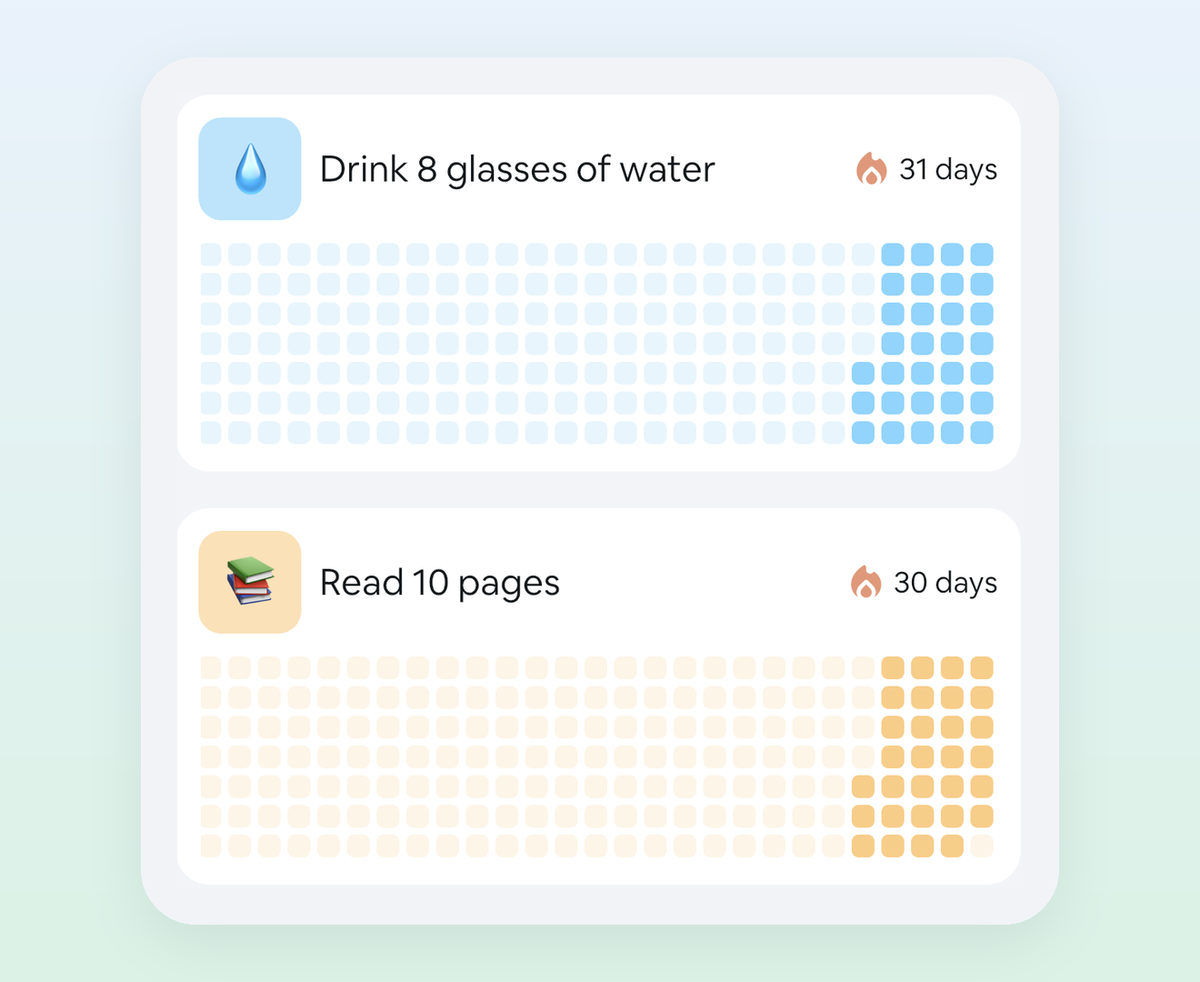
It’s free for up to three habits on iPhone and Android. Set it up on New Year’s Eve and your first coins come in on January 1st.
✅ Try Habit Rewards: the habit tracker that pays you
Every habit pays coins by how hard it is (1, 4, 8 or 16). Write your own reward list, put a coin price on each treat, and claim it once you've earned it.
- Daily, weekly and monthly habits, plus one-off tasks that pay coins
- Reminders, streaks and home-screen widgets
- A 10-coin Skip for the days you can't
- Free for three habits, on iPhone and Android

On a computer? Scan the code with your phone (it opens the App Store or Google Play), or get it on the App Store.

Using Notion?
Start with our free Notion habit tracker and formulas, or get the aesthetic Notion Habit Tracker template with heatmaps and streaks.
More articles you may be interested in:
- Free Notion Habit Tracker Templates (and How to Build Your Own)
- Trigger, Behavior, Reward: The Habit Loop Explained With Examples
- Reward Jar Ideas for Adults: How to Set One Up (+ 40 Slips)
- 50 Realistic New Year's Resolutions for 2027 (and the Daily Habit for Each)
- How to Reward Yourself for Weight Loss: 50 Non-Food Rewards
- Habitica Habits vs Dailies vs To Do's: Which to Use (With Examples)
Free habit tools and printables
Free, in your browser, no sign-up.