
Habit stacking means attaching a new habit to one you already do every day, so the old habit reminds you of the new one. You don’t need to remember to floss. You need to remember to brush your teeth, which you already do.
The idea is everywhere since James Clear’s Atomic Habits, but most lists of examples stop at “after coffee, meditate”. Below is the formula, 80 stacks sorted by when and why you’d use them, and the reasons a stack stops working after a week.
The habit stacking formula
Clear’s version is one sentence:
After [current habit], I will [new habit].
The current habit is your anchor. The term comes from BJ Fogg, the Stanford researcher behind Tiny Habits, whose recipe is “After I [anchor], I will [tiny behavior]”, followed by a small celebration. Clear’s twist is the chain: once the new habit sticks, it becomes the anchor for the next one.
- After I pour my morning coffee, I will write down my top task for today.
- After I write down my top task, I will drink a glass of water.
- After I drink the water, I will do ten squats.
Why it works
A goal like “exercise more” leaves the when and where open, so every day you have to decide again. A stack decides once. Psychologists call this kind of plan an implementation intention, an “if this happens, I’ll do that” plan. In Peter Gollwitzer and Paschal Sheeran’s 2006 review of 94 studies, people who made these plans reached their goals noticeably more often than people who only set the goal.
The anchor also does the reminding for you. You don’t need an alarm for “after I brush my teeth”. It happens anyway.
How to build a stack in five minutes
- List your anchors. Write down what you do every day without fail: wake up, turn off the alarm, coffee, shower, brush teeth, get dressed, sit down at your desk, lunch, get home, dinner, dishes, plug in your phone, get into bed.
- Pick the habit you want, in its smallest form. Two minutes to start. “Read one page”, not “read more”. “Put on running shoes”, not “run 5K”.
- Match it to an anchor in the same place, at a time you have room. Stretching fits after you get out of bed. It doesn’t fit after you sit down at your desk at 9:00 with a meeting at 9:05.
- Write the sentence down where you’ll see it: on a sticky note by the anchor, or in your habit tracker.
- Add a reward at the end. Clear’s fourth law is “make it satisfying”. Fogg ends each recipe with a celebration. Finish the stack with something you enjoy, so the last step is the one you look forward to.
Our free habit stacking template walks you through these steps for morning, daytime and evening, and prints your stacks with a week of checkboxes. To put clock times on a whole routine, use the morning and night routine checklist maker.
80 habit stacking examples
Each one is a starting point. Swap the anchor for something you really do every day, and shrink the new habit until it feels almost too easy.
Morning (15)
- After I turn off my alarm, I will sit up and put both feet on the floor.
- After I get out of bed, I will make my bed.
- After I make my bed, I will open the curtains.
- After I walk into the kitchen, I will drink a full glass of water.
- After I start the kettle or coffee machine, I will stretch until it’s ready.
- After I pour my coffee, I will write down the one task that matters today.
- After I pour my coffee, I will read one page of a book before my phone.
- After I brush my teeth, I will floss one tooth (and usually the rest).
- After I brush my teeth, I will take my vitamins.
- After I get out of the shower, I will put on moisturiser and sunscreen.
- After I get dressed, I will do one minute of breathing.
- After I sit down for breakfast, I will say what I’m grateful for today.
- After I finish breakfast, I will put my dishes straight in the dishwasher.
- After I put on my shoes, I will check today’s weather and calendar.
- After I lock the front door, I will listen to a language lesson instead of music.
Work and study (12)
- After I sit down at my desk, I will close every tab I don’t need.
- After I open my laptop, I will work on my top task for 25 minutes before email.
- After I finish a meeting, I will write down the next action in one line.
- After I hang up a call, I will stand up and refill my water.
- After I send an important email, I will clear one more item from my inbox.
- After I finish lunch, I will walk for ten minutes.
- After I make my afternoon coffee, I will review my task list.
- After I close my laptop for the day, I will write tomorrow’s first task on a sticky note.
- After I open my textbook, I will set a 25-minute timer.
- After I finish a study session, I will test myself on three things without notes.
- After I get to class, I will put my phone in my bag on silent.
- After I get home from work, I will change out of work clothes before sitting down.
Evening (12)
- After I finish dinner, I will wipe the kitchen counter.
- After I load the dishwasher, I will prep tomorrow’s lunch.
- After I prep my lunch, I will set out tomorrow’s clothes.
- After I turn off the TV, I will tidy the living room for five minutes.
- After I put on my pyjamas, I will write one line in a journal.
- After I write in my journal, I will write down three good things from today.
- After I brush my teeth at night, I will do my skincare.
- After I plug in my phone, I will leave it outside the bedroom.
- After I get into bed, I will read ten pages.
- After I turn off the light, I will take five slow breaths.
- After I set my alarm, I will check that my keys and bag are by the door.
- After I finish the last episode for the night, I will close the app instead of letting the next one play.
Exercise and fitness (10)
- After I get out of bed, I will do one push-up.
- After I make my coffee, I will do 20 squats while it brews.
- After I brush my teeth, I will hold a plank for 30 seconds.
- After I get home from work, I will change straight into workout clothes.
- After I change into workout clothes, I will put on my workout playlist.
- After I park at work, I will take the stairs.
- After every bathroom break, I will do ten calf raises.
- After I finish a workout, I will drink a glass of water and log it.
- After I sit down to watch TV, I will stretch for the first ten minutes.
- After I put my kids to bed, I will roll out the yoga mat.
ADHD-friendly stacks (10)
These lean on things that happen whether you plan for them or not, and keep each step tiny. They’re a planning trick, not a treatment.
- After I pick up my phone in the morning, I will open my to-do list before any other app.
- After I take my medication, I will drink a full glass of water.
- After I put my keys down, I will put them in the same bowl by the door.
- After I walk into a room, I will put away one thing that’s out.
- After I get a notification, I will check whether it’s the thing I’m doing right now.
- After I sit down to work, I will put on the same “focus” playlist.
- After I finish a task, I will tick it off and pick the next one before standing up.
- After I make a cup of tea, I will spend the time it brews on one two-minute chore.
- After I get home, I will hang my bag on the hook before anything else.
- After I start a show, I will set a timer for when I’ll stop.
More setups that work with ADHD brains in our ADHD habit tracker guide.
Home and family (8)
- After I start the washing machine, I will clear one surface.
- After I take out the bin, I will put a new bag in straight away.
- After I unpack the shopping, I will write the next shopping list.
- After I pick my kids up, I will ask them one question about their day.
- After my kids brush their teeth, I will read them one story.
- After I feed the pet, I will refill its water.
- After I get the post, I will open it over the recycling bin.
- After I finish cooking, I will wash the pan before eating.
Money (6)
- After I get paid, I will move a fixed amount to savings.
- After I buy something online, I will add it to my spending note.
- After I put something in an online basket, I will wait 24 hours before buying.
- After my morning coffee on Sundays, I will check my account balance.
- After I make coffee at home instead of buying one, I will move that money to savings.
- After I pay a bill, I will check whether that subscription is still worth it.
Relationships and self-care (7)
- After I sit down for lunch, I will text one friend.
- After I get into the car to go home, I will call a family member.
- After my partner gets home, I will ask about their day before I talk about mine.
- After I close my laptop on Friday, I will plan one fun thing for the weekend.
- After I check social media, I will put my phone face down for ten minutes.
- After I wash my face, I will say one kind thing to myself in the mirror.
- After I get into bed on Sundays, I will write down what I’m looking forward to this week.
Why stacks fall apart (and the fix)
- The anchor isn’t daily. “After I go to the gym” is a habit you’re still building, not an anchor. Anchors have to be things you’d do even on your worst day.
- The new habit is too big. “After I get home, I will run 5K” competes with dinner, tiredness and the sofa. Shrink it to “put on my running shoes”. Most days you’ll go anyway.
- The places don’t match. If the anchor is in the kitchen and the habit needs your desk, you’ll forget on the walk between them.
- The chain is too long. A seven-step morning routine breaks at the first missed link, and then everything after it goes too. Start with one to three habits per stack.
- Nothing feels good at the end. A stack of chores with no payoff is a list, and lists get ignored. Finish with something you enjoy, or something that counts toward something you want.
- You don’t track it. Without a record, one skipped day becomes three before you notice. A checkmark you can see is what keeps the chain going.
Habit stacking with Habit Rewards
Habit Rewards is a habit tracker that pays you for each habit you check off: 1, 4, 8 or 16 coins, depending on how hard it is. You make your own list of rewards, like an episode of a show, a nice coffee or a new book, give each one a coin price, and claim it when your balance covers it. That’s the “make it satisfying” step, built in.
For stacks:
- Groups: put your morning stack in a Morning group and your evening stack in an Evening group, so Home shows one part of the day at a time. Groups are free.
- Order: drag your habits into the order you do them.
- The sentence: write the “After I…” line in each habit’s description, so you see it every time you open the habit.
- Reminders: set a reminder for around the time of your anchor. The first reminder on each habit is free; more come with Pro.
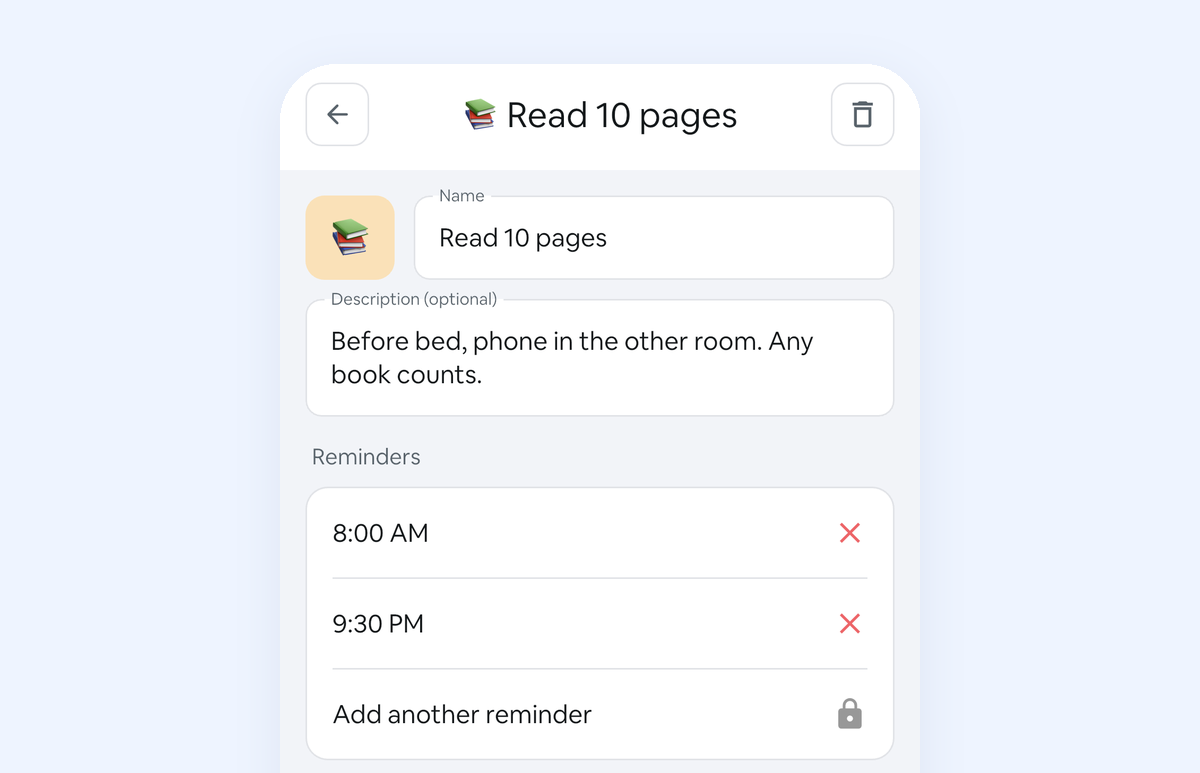
It’s free for three habits and three rewards on iPhone and Android.
FAQ
What is habit stacking? A way to build a new habit by doing it straight after something you already do every day. The existing habit, the anchor, works as the reminder. The formula from Atomic Habits is “After [current habit], I will [new habit].”
Who came up with habit stacking? The term was popularised by S.J. Scott’s book Habit Stacking and by James Clear’s Atomic Habits (2018). Clear credits BJ Fogg, whose Tiny Habits method attaches each new habit to an existing “anchor” moment.
How many habits should I stack? Start with one new habit per anchor, and no more than three in a chain. Add the next one when the first happens without you thinking about it.
What is a good habit stacking example for beginners? “After I pour my morning coffee, I will write down the one task that matters today.” The anchor happens every day, the habit takes under a minute, and both happen in the same place.
Does habit stacking work for ADHD? Many people with ADHD find it easier to hang a habit on something that happens anyway than to remember it at a set time. Keep the habits tiny and the anchors physical (keys, medication, a kettle). It isn’t a treatment.
How long does it take for a stack to become automatic? It varies a lot. In a 2010 University College London study, simple daily habits took a median of 66 days to feel automatic, with a range of 18 to 254 days. More in how long it takes to form a habit.
✅ Try Habit Rewards: the habit tracker that pays you
Every habit pays coins by how hard it is (1, 4, 8 or 16). Write your own reward list, put a coin price on each treat, and claim it once you've earned it.
- Daily, weekly and monthly habits, plus one-off tasks that pay coins
- Reminders, streaks and home-screen widgets
- A 10-coin Skip for the days you can't
- Free for three habits, on iPhone and Android
On a computer? Scan the code with your phone (it opens the App Store or Google Play), or get it on the App Store.

Using Notion?
Start with our free Notion habit tracker and formulas, or get the aesthetic Notion Habit Tracker template with heatmaps and streaks.
More articles you may be interested in:
- Free Notion Habit Tracker Templates (and How to Build Your Own)
- Trigger, Behavior, Reward: The Habit Loop Explained With Examples
- Reward Jar Ideas for Adults: How to Set One Up (+ 40 Slips)
- 50 Realistic New Year's Resolutions for 2027 (and the Daily Habit for Each)
- New Year's Resolution Tracker: How to Keep Track of Your 2027 Resolutions
- How to Wake Up Early (and Make It a Habit That Sticks)
Free habit tools and printables
Free, in your browser, no sign-up.