
Seeing your progress is half of why habit tracking works. A row of crosses, a filling grid or a growing number turns “I’ve been pretty good lately” into something you can actually look at, and that look is a small reward in itself.
But the picture you choose matters. A visualization that suits a daily habit can quietly punish a weekly one, and a streak that motivates on day 20 can make you quit on day 21. Here are seven ways to see your habits, what each one is good at, and where each one backfires.
| Visualization | Best for | Watch out for |
|---|---|---|
| Chain calendar | Daily habits, early on | One gap feels like failure |
| Year heatmap | Seeing the long run | Slow to feel rewarding |
| Streak counter | Daily habits you rarely miss | Losing a big number |
| Completion rate | “3 times a week” habits | Feels abstract |
| Progress bar | Habits with a target | Stalls after the target |
| Paper clip jar | Reps within a day | Physical, stays at home |
| Coin balance | Habits with a slow payoff | Needs rewards you want |
1. The chain calendar
The classic: a calendar on the wall, and a big X for every day you did the thing. After a few days you have a chain, and your job is not to break it. It works because the next X is always easy to picture and always visible.
Use it for daily habits in their first month, when you most need to see that you’ve started. Our printable habit tracker is a monthly grid for exactly this, with a reward box for each habit.
Backfires when you miss a day and the broken chain looks like proof you’ve failed. Decide in advance what a missed day means: a “never miss twice” rule, or a planned skip day that keeps the chain intact.
2. The year heatmap
Shrink the chain calendar down to one small square per day and lay out a whole year, like the contribution graph on a developer’s profile. Days you did more are darker. After a few months the pattern tells you things a single week can’t: which weekdays you skip, whether holidays derail you, how long your good runs last.
Use it for habits you plan to keep for a year or more. The yearly habit tracker gives you one page per habit, 12 months by 31 days.
Backfires when you need motivation this week. A heatmap rewards patience, not today.
3. The streak counter
A single number: 47 days. It’s the simplest picture there is, and for a lot of people the most compelling. Nobody wants to go back to zero.
Use it for habits you can do every day without exception, like taking a vitamin or making your bed.
Backfires when the number gets big. Losing a 200-day streak feels so bad that some people stop tracking altogether. Pair a streak with a way to protect it on a sick day.
4. The completion rate
Instead of “did I do it today?”, the completion rate asks “how often am I doing it?” Seventy percent of days this month is a much kinder picture than a broken chain, and it’s the honest one for habits like “gym three times a week”, where a rest day isn’t a miss.
Use it for weekly and flexible habits, and for anyone who finds streaks stressful.
Backfires when you need a push today. A rate is a summary, not a nudge.
5. The progress bar
A bar that fills toward a target: 12 of 20 workouts this month, 9 of 24 books this year. It turns a habit into a project with a finish line, which is very motivating near the end.
Use it for habits with a natural count. The reading tracker puts a reward at 25, 50, 75 and 100 percent of your book goal.
Backfires when you hit the target and the bar has nowhere to go. Set the next target before you finish the current one.
6. The paper clip jar
A trick made famous by Atomic Habits: two jars on your desk, one full of paper clips. Each time you do a rep, like a sales call or a set of push-ups, move one clip across. By the end of the day, the full jar shows your effort in a way you can see from across the room.
Use it for habits you repeat many times a day.
Backfires when you’re not at your desk. It’s a home-or-office tool, and it resets every day.
7. The coin balance
Every habit you check off adds coins to a balance, and the balance buys rewards you’ve chosen and priced yourself. Most visualizations show what you’ve done. A balance also shows what it’s worth: 140 coins means you’re 60 away from the concert ticket.
Use it for habits whose real payoff is far away, like exercise, studying or saving, where you need something to look forward to sooner.
Backfires when the rewards don’t excite you. Price things you actually want; here are 70 ideas.
This is the one we built Habit Rewards around. Each habit pays coins by how hard it is (1, 4, 8 or 16), and your reward list shows what they buy. It also gives you several of the pictures above: every habit has a calendar with done, skipped and failed days in different colors, current and longest streaks, and a completion rate, and a statistics page sums up all your habits and the coins you’ve earned. A Skip costs 10 coins and keeps a streak alive on the days you can’t.
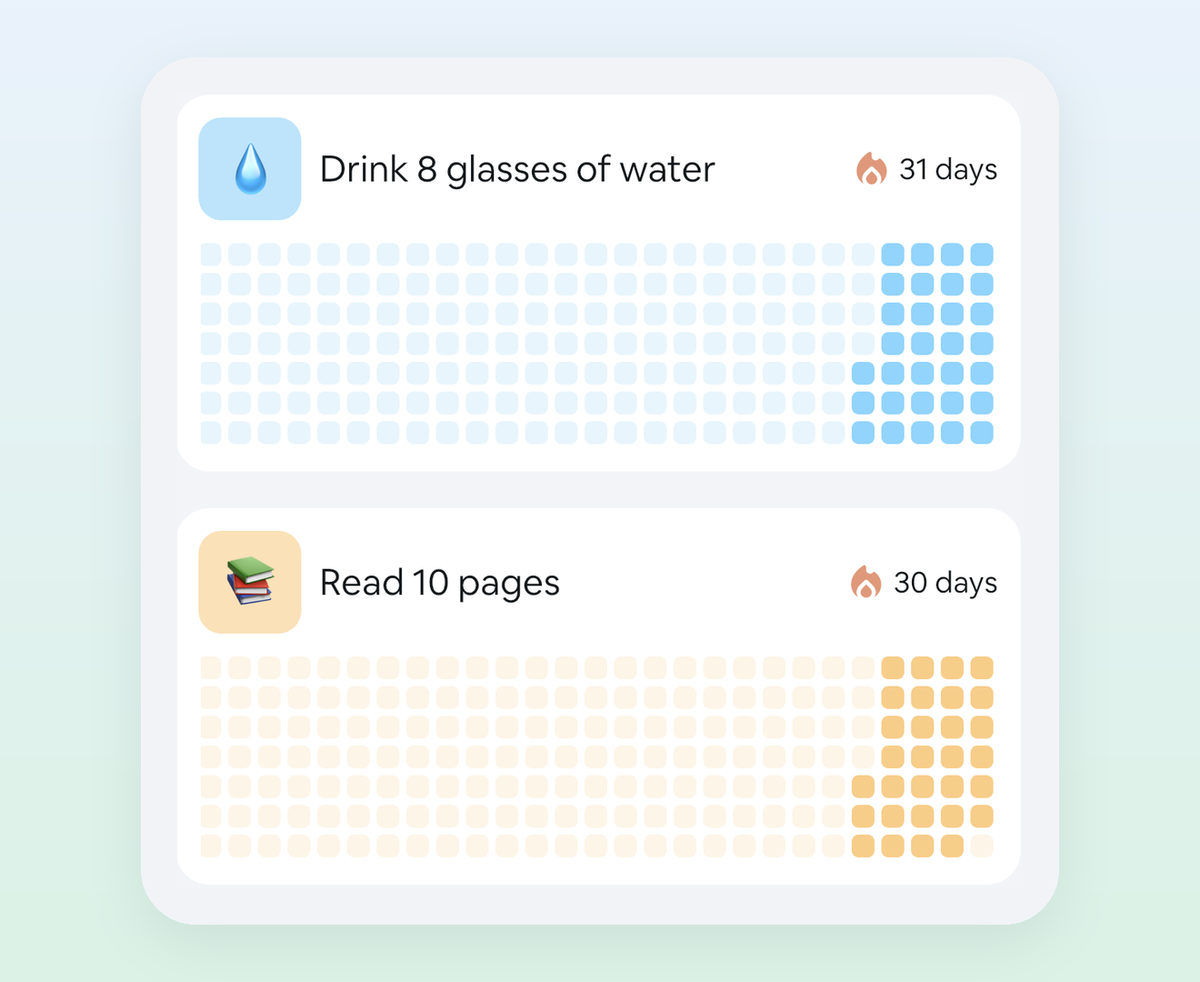
Which one should you use?
Match the picture to the habit:
- Every day, no exceptions: a chain calendar or a streak, with a plan for the day you miss.
- A few times a week: a completion rate, so rest days don’t look like failures.
- Toward a number: a progress bar, with the next goal ready.
- For the long run: a year heatmap.
- When the payoff is far away: a coin balance and a reward list.
Most people do best with two: one that shows today (a chain, a streak or a balance) and one that shows the long run (a rate or a heatmap). Prefer a spreadsheet? The free habit tracker spreadsheet has monthly grids and a rewards tab. More printables: free habit tools.
Habit Rewards is free on iPhone and Android.
✅ Try Habit Rewards: the habit tracker that pays you
Every habit pays coins by how hard it is (1, 4, 8 or 16). Write your own reward list, put a coin price on each treat, and claim it once you've earned it.
- Daily, weekly and monthly habits, plus one-off tasks that pay coins
- Reminders, streaks and home-screen widgets
- A 10-coin Skip for the days you can't
- Free for three habits, on iPhone and Android

On a computer? Scan the code with your phone (it opens the App Store or Google Play), or get it on the App Store.

Using Notion?
Start with our free Notion habit tracker and formulas, or get the aesthetic Notion Habit Tracker template with heatmaps and streaks.
More articles you may be interested in:
Free habit tools and printables
Free, in your browser, no sign-up.